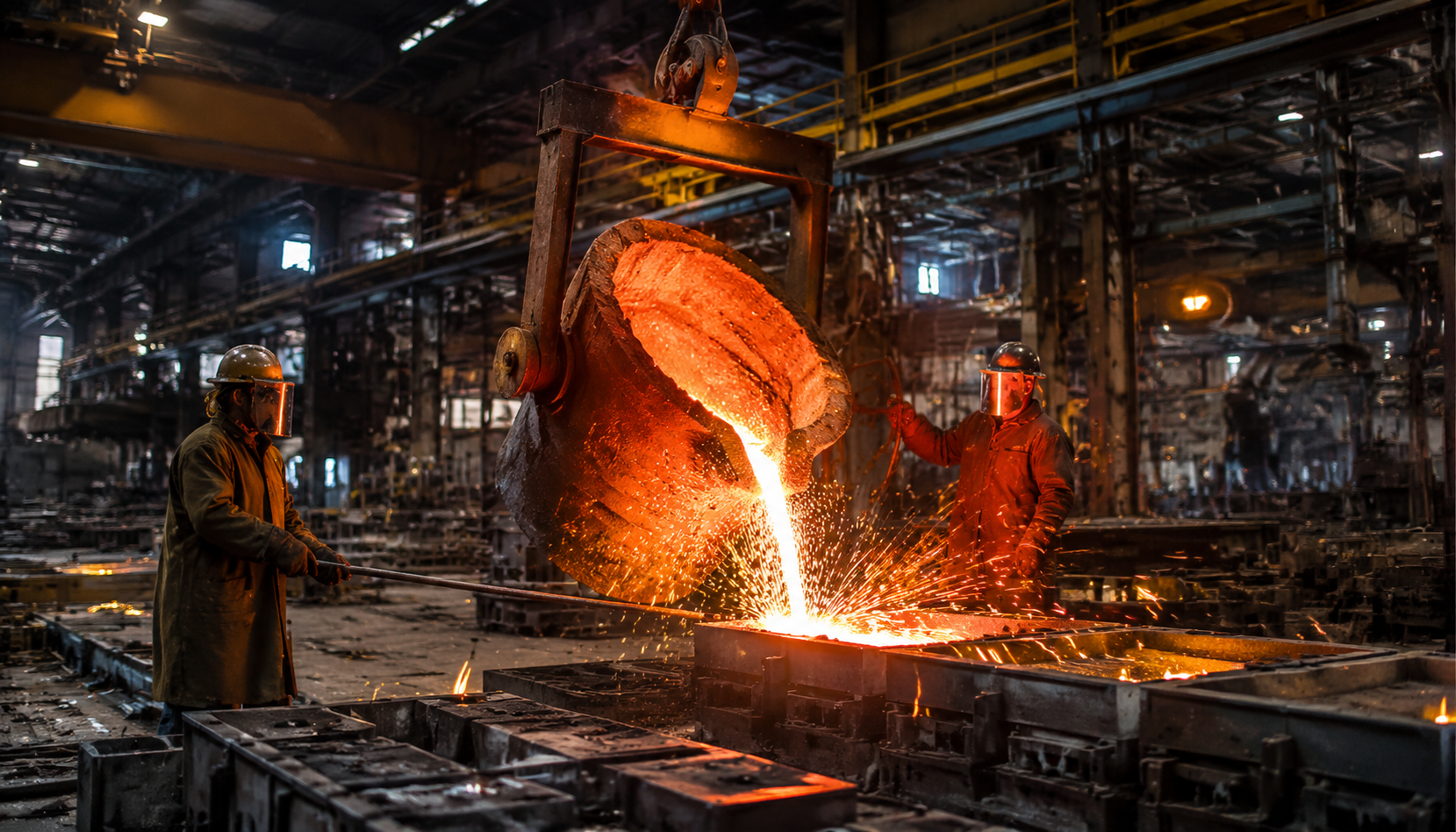
You've got a part that needs to handle serious load — maybe a valve body for a 1,500 psi hydraulic system, or a suspension knuckle for a heavy truck. Your first instinct might be steel. It's strong. It's proven. But here's the thing: ductile iron casting advantages are forcing engineers to rethink that default choice.
Over the last decade, ductile iron has quietly taken over applications that were once steel-only territory. Automotive OEMs now specify ductile iron for crankshafts, control arms, and brake calipers. Oil and gas companies use it for valve bodies rated to API 6D. And construction equipment manufacturers rely on it for gearboxes that see 50,000+ hours of service.
Why the shift? Because ductile iron delivers 60-120 ksi tensile strength at 30-50% lower cost than steel, with better machinability and damping characteristics. That's not marketing — that's metallurgy.
Let's dig into the actual numbers, the trade-offs, and the real-world applications so you can decide if ductile iron is right for your next project.
What Makes Ductile Iron Different? (The Metallurgy Behind the Strength)
To understand the advantages, you need to know what's happening at the microscopic level. Ductile iron — also called nodular iron or spheroidal graphite iron (SGI) — gets its name from the shape of the graphite inside it.
In gray iron, graphite forms as flakes. Those flakes act like internal crack starters. Under tension or impact, the cracks propagate along the flakes, and the part fractures. That's why gray iron has near-zero ductility and poor impact resistance.
In ductile iron, the graphite forms as tiny spheres — nodules. Spheres don't concentrate stress like flakes do. So when you apply load, the iron matrix — not the graphite — takes the strain. That changes everything.
Typical microstructure of ductile iron (per ASTM A536):
- Graphite nodules: 6-12% by volume, 20-50 microns diameter
- Matrix: ferrite (soft/ductile) or pearlite (hard/strong) or a mix
- Nodularity: 80% minimum per ASTM E2567 (most foundries hit 90%+)
- Nodule count: 100-400 nodules/mm²
The magic is in the nodularity. That's what gives you 10-18% elongation (vs 0% for gray iron) and impact values of 10-15 ft-lb at room temperature (vs 2-4 ft-lb for gray iron).
And that's just Grade 60-40-18. If you move up to Grade 100-70-03, you get 100 ksi tensile and 70 ksi yield — comparable to many cast steels, but at a fraction of the cost.
Let's look at the specific grades and what they mean for your design.
The 5 Key Advantages That Matter for Your Application
1. Strength-to-Weight Ratio That Beats Steel in Many Cases
Ductile iron's tensile strength ranges from 60,000 psi (Grade 60-40-18) to 120,000 psi (Grade 120-90-02). But the real win is how that strength translates to real parts.
Because ductile iron has better fluidity than steel (it fills thin sections more easily), you can design parts with thinner walls and still get full strength. A ductile iron valve body might have 3/8" walls while the same part in cast steel needs 1/2" walls. That's 25% less material — and 25% less weight.
For automotive applications, that weight reduction is gold. A ductile iron knuckle might weigh 18 lbs versus 24 lbs for the same part in forged steel. Over a production run of 500,000 units, that's 3 million pounds of material saved.
Specific strength data (yield/tensile):
- ASTM A536 60-40-18: 40 ksi yield / 60 ksi tensile / 18% elongation
- ASTM A536 80-55-06: 55 ksi yield / 80 ksi tensile / 6% elongation
- ASTM A536 100-70-03: 70 ksi yield / 100 ksi tensile / 3% elongation
- EN-GJS-400-18 (ISO 1083): 250 MPa yield / 400 MPa tensile / 18% elongation
- EN-GJS-700-2: 420 MPa yield / 700 MPa tensile / 2% elongation
Compare that to cast steel (65 ksi yield / 85 ksi tensile typical) and you'll see ductile iron matches or exceeds it in many grades.
2. Cost — The 30-50% Advantage
This is the big one. Ductile iron castings typically cost 30-50% less than equivalent steel castings, and 40-60% less than steel forgings.
Where does the saving come from?
- Lower melting temperature: Ductile iron melts at ~2,600°F vs steel at ~2,900°F. That's 10-15% less energy per ton.
- Better fluidity: Ductile iron fills molds more easily, reducing mis-runs and cold shuts. Defect rates drop from 5-8% (steel) to 2-4% (ductile iron).
- Faster machining: Ductile iron machines 2-3x faster than steel. A ductile iron valve body might take 4 minutes of machining vs 10-12 minutes for the same part in steel.
- No heat treatment needed: Most ductile iron grades achieve their mechanical properties as-cast. Steel almost always requires heat treatment (normalizing, quenching & tempering).
Real cost example: A 50-lb valve body for a chemical plant — ductile iron (ASTM A395) comes in at ~$550-650 per casting. Cast steel (ASTM A216 WCB) runs ~$850-1,050. For an order of 500 units, that's a saving of $150,000-200,000.
3. Machinability — Cut Your Cycle Times
If you're machining parts in-house, ductile iron's machinability is a game-changer. It has a machinability rating of 70-90% relative to free-cutting steel (1212), versus cast steel at 40-60%.
What that means in practice: you can run higher speeds and feeds, get better surface finish, and use 20-30% less tooling. A typical ductile iron part might be machined at 600-800 surface feet per minute (SFM) with carbide inserts, while the same part in steel needs 300-500 SFM.
And the chips? Ductile iron produces short, broken chips that don't clog coolant systems. Steel produces long stringy chips that cause downtime and safety issues.
Hardness ranges for machining:
- Ferritic ductile iron (60-40-18): 140-190 BHN — easy machining
- Ferritic-pearlitic (80-55-06): 180-230 BHN — good machining
- Pearlitic (100-70-03): 230-280 BHN — moderate machining
For comparison, cast steel typically runs 160-220 BHN but is far more abrasive due to carbides.
4. Damping Capacity — Quieter, Smoother Operation
Ductile iron has a damping capacity 4-6x higher than steel. That means it absorbs vibration instead of transmitting it. For gearboxes, engine components, and machine tool structures, this is a huge advantage.
A ductile iron gear housing will run 3-5 dB quieter than the same housing in steel. Over 8,000 hours of operation, that reduction in vibration also means less fatigue on bearings and seals.
The damping comes from the graphite nodules themselves — they act like millions of tiny shock absorbers. Steel, with no graphite, transmits vibration directly through the matrix.
5. Fatigue Strength and Wear Resistance
Ductile iron's fatigue endurance limit (at 10⁷ cycles) is typically 30-40 ksi for un-notched specimens — comparable to many steels. But here's the trick: ductile iron responds exceptionally well to surface treatments.
Shot peening can boost the fatigue limit by 20-30%. Induction hardening of selected areas (like bearing journals or cam lobes) can produce surface hardness of 45-55 HRC while keeping the core at 25-35 HRC for toughness.
For wear resistance, ductile iron with a pearlitic matrix (80-55-06 or 100-70-03) wears at a rate similar to medium-carbon steel. Add induction hardening or through-hardening, and it competes with hardened steel at lower cost.
Wear rate comparison (pin-on-disc test, ASTM G99):
- Ductile iron (pearlitic): 0.8-1.2 mg/1000 cycles
- Cast steel (1040 normalized): 0.6-1.0 mg/1000 cycles
- Gray iron (class 40): 1.5-2.5 mg/1000 cycles
Ductile Iron vs. Steel vs. Gray Iron – A Side-by-Side Comparison
Let's put the numbers in one place so you can see the trade-offs clearly.
| Property | Ductile Iron (80-55-06) | Cast Steel (65-85 ksi) | Gray Iron (Class 40) |
|---|---|---|---|
| Tensile strength (ksi) | 80 | 85 | 40 |
| Yield strength (ksi) | 55 | 65 | N/A |
| Elongation (%) | 6 | 18-25 | 0 |
| Hardness (BHN) | 180-230 | 160-220 | 180-220 |
| Impact (ft-lb at RT) | 8-12 | 15-25 | 2-4 |
| Damping capacity | High | Low | Very high |
| Cost ($/lb) | $0.80-1.20 | $1.40-2.00 | $0.50-0.80 |
| Machinability rating | 70-90% | 40-60% | 80-100% |
The takeaway: ductile iron fills the gap between cheap/brittle gray iron and expensive/ductile steel. It gives you strength near steel, cost near gray iron, and machinability that beats both.
Where Ductile Iron Casting Shines: Real-World Applications
Automotive and Heavy Truck
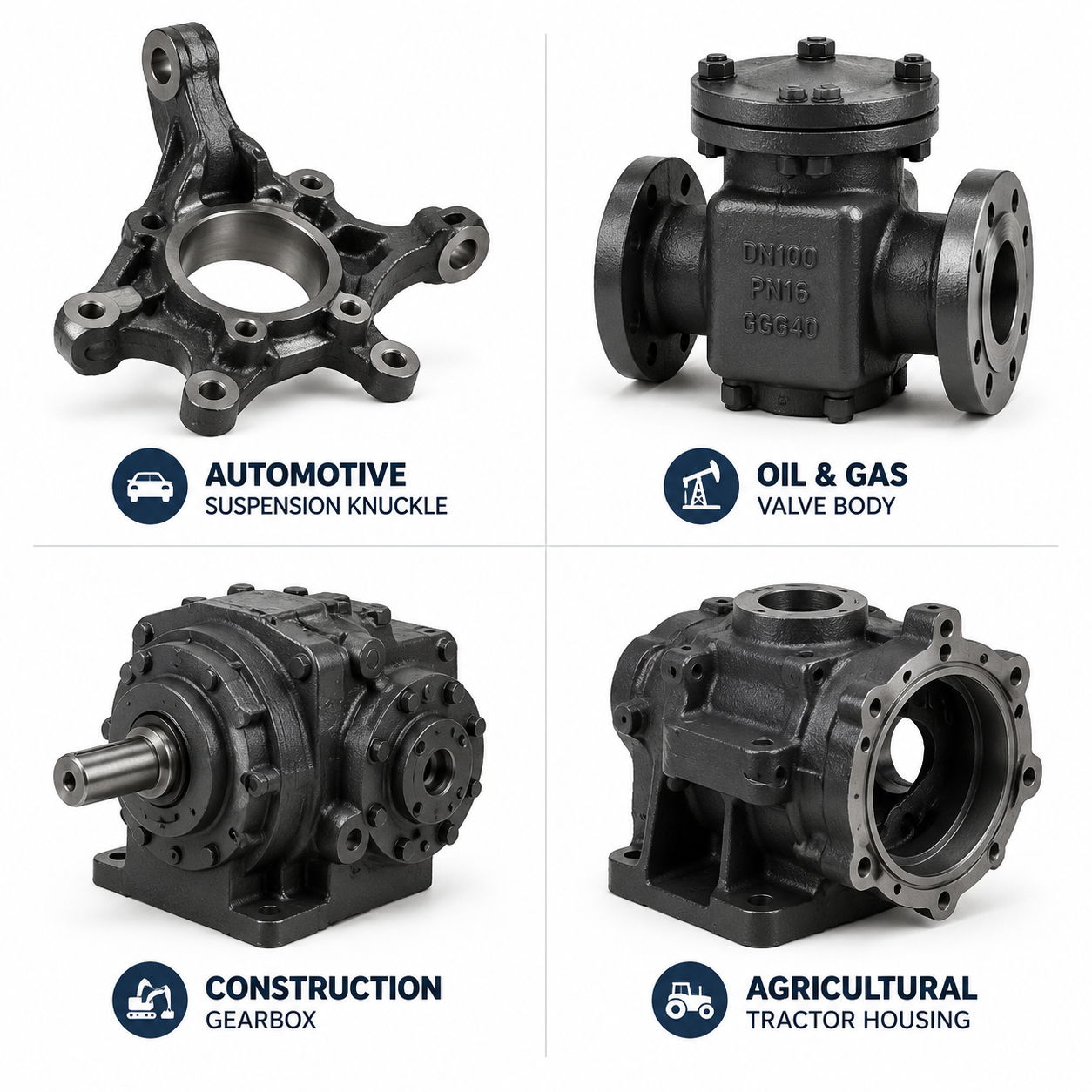
Ductile iron is the material of choice for suspension components (control arms, knuckles, trailing arms), powertrain parts (crankshafts, differential carriers, gear housings), and brake components (calipers, brackets). Over 60% of all ductile iron produced globally goes into vehicles.
Ford's F-150 uses ductile iron for its front knuckles. Volvo trucks specify ductile iron for rear axle housings. The reason? It handles fatigue loads of 50,000+ cycles with no cracking, at half the cost of forged steel.
Oil and Gas
API 6D and API 6A valve bodies in ductile iron (ASTM A395 or A536) are standard for pipeline valves, wellhead equipment, and flow control. Ductile iron handles pressures up to 2,500 psi in Class 300 and Class 600 valves.
One major valve manufacturer told us they switched 80% of their cast steel valve bodies to ductile iron over the past 5 years. The reason: zero field failures in 7 years, and 35% lower cost per unit.
Construction and Mining
Gearboxes, pulley hubs, idler rollers, and bucket teeth — ductile iron handles high impact and abrasive conditions. Austempered ductile iron (ADI) is now used for excavator track pads and mining bucket liners, replacing hardened steel at 40% lower weight.
Agriculture
Tractor housings, PTO components, hitch brackets — ductile iron offers the strength to handle 300+ HP loads with the corrosion resistance to survive years in the field.
Design Tips to Maximize Ductile Iron's Advantages
You don't just specify ductile iron and hope for the best. To get the full benefit, you need to design for the material. Here's what experienced engineers do:
- Keep wall thickness uniform. Ductile iron solidifies with a "skin" effect — thin sections cool fast (ferritic structure), thick sections cool slow (pearlitic structure). Aim for wall thickness ratios under 2:1 to avoid inconsistent properties.
- Use radii generously. Ductile iron has good ductility, but sharp corners create stress concentrations. A radius of 2-3x the wall thickness at internal corners will eliminate cracking concerns.
- Specify nodularity. Ask your foundry for 85% minimum nodularity per ASTM E2567. Below 80%, you lose ductility and impact resistance fast.
- Consider ADI for extreme strength. Austempered ductile iron (ASTM A897) offers strengths up to 230 ksi (Grade 1900-1400-1). It's a heat treatment step that adds $0.20-0.40/lb but doubles the strength.
- Design for as-cast surfaces. Ductile iron's as-cast surface finish (250-500 RMS) is often acceptable for non-sealing surfaces. If you need a better finish, add 0.060-0.090" machining stock.
Common Mistakes Engineers Make When Specifying Ductile Iron
I've seen these mistakes cost companies tens of thousands of dollars. Avoid them:
Mistake #1: Specifying "ductile iron" without a grade. There are 6+ grades in ASTM A536 alone. If you just say "ductile iron," you'll get whatever the foundry has on hand — probably 60-40-18, which may not be strong enough. Always specify the grade.
Mistake #2: Assuming all foundries produce the same quality. Nodularity varies wildly. A foundry with good process control (CE analysis, magnesium treatment, inoculation) will deliver 90%+ nodularity. A marginal foundry might be at 70-75%. The difference in fatigue life is 2-3x.
Mistake #3: Using ductile iron where gray iron's damping is needed. Gray iron still wins for pure vibration damping — like engine blocks and machine tool bases. Ductile iron has 40-60% of gray iron's damping capacity. For a gearbox housing, that's fine. For a precision grinder base, stay with gray iron.
Mistake #4: Forgetting about corrosion in thin sections. Ductile iron corrodes at roughly the same rate as steel (5-10 mils/year in industrial atmospheres). If you're designing a 0.125" wall for a valve body, add 0.060" corrosion allowance or specify a coating.
Mistake #5: Ignoring the supplier's capability. Not every foundry can produce large ductile iron castings (500+ lbs) with consistent nodularity. A 200-lb valve body needs a foundry with experience in heavy-section ductile iron, where cooling rate control is critical.
FAQ – Ductile Iron Casting Advantages
What are the main ductile iron casting advantages over steel?
Ductile iron offers 60-120 ksi tensile strength at 30-40% lower cost than steel forgings or castings. It also provides better damping capacity (4-6x higher than steel), superior machinability (70-90% rating vs 40-60% for steel), and excellent wear resistance. For many applications like gearboxes, valves, and suspension components, ductile iron outperforms steel on both cost and performance.
Is ductile iron stronger than gray iron?
Yes, significantly. Ductile iron has tensile strength of 60-120 ksi (414-827 MPa) versus gray iron's 20-60 ksi (138-414 MPa). Ductile iron also offers 10-18% elongation (vs near-zero for gray iron) and 3-4x higher impact resistance. That's why ductile iron replaced gray iron in critical safety parts like brake calipers, wheel hubs, and pressure-rated valve bodies.
What is the typical cost difference between ductile iron and steel castings?
Ductile iron castings typically cost 30-50% less than steel castings and 40-60% less than steel forgings. The savings come from lower melting temperatures (2,600°F vs 2,900°F for steel), better fluidity reducing defect rates, and faster machining cycles (2-3x faster). A typical ductile iron valve body might cost $0.80-1.20/lb versus $1.40-2.00/lb for the same part in cast steel.
Can ductile iron be welded or heat treated?
Yes, ductile iron can be welded using nickel-iron electrodes (ENiFe-CI) with preheat of 400-600°F. It can also be heat treated — annealing (1,650°F), normalizing (1,600-1,700°F), or austempering (1,500-1,600°F) to produce ADI (Austempered Ductile Iron) with tensile strengths up to 230 ksi. Over 80% of all ductile iron castings are supplied in the as-cast or annealed condition.
What industries use ductile iron castings the most?
The top industries are: automotive (35-40% of global production — crankshafts, knuckles, control arms), oil and gas (25-30% — valve bodies, pump housings, fittings), construction and mining (15-20% — gearboxes, buckets, wear parts), and agricultural equipment (10-15% — housings, brackets, hitch components). Over 14 million tons of ductile iron are produced globally each year.
Next Steps – Getting the Right Ductile Iron Casting for Your Project
You've seen the numbers. Ductile iron gives you 60-120 ksi strength, 30-50% cost savings over steel, and machinability that cuts cycle times in half. But the key — and I can't stress this enough — is finding a foundry that can actually deliver on those promises.
Nodularity, grade consistency, heat treatment control — these aren't things you want to leave to chance. A bad casting can cost you months in delays and thousands in rework.
That's where VerifyCasting comes in. We don't cast parts ourselves. Instead, we vet and audit foundries across China — over 1,200 ISO-certified facilities — so you get a shortlist of suppliers who can actually do the job. We check their process control, their testing equipment, their track record with your specific grade and application.
If you're specifying a ductile iron casting and you want to avoid the common mistakes we covered, here's what to do next:
- Send us your part drawing or 3D model
- Tell us the grade (or we can help you select one)
- We'll match you with 3-5 qualified foundries and provide competitive quotes within 5 business days
Need Help with Ductile Iron Casting?
Send your part specifications and let us match you with pre-audited foundries that meet your quality and budget requirements. Get competitive quotes in 5 days.
Submit Your InquiryNeed Help Specifying Casting Materials?
Material choice affects cost by 30-60% and performance by orders of magnitude. Our metallurgists will review your application and recommend optimal grades — with Chinese GB equivalents and cost comparisons.
Get Material Consultation →