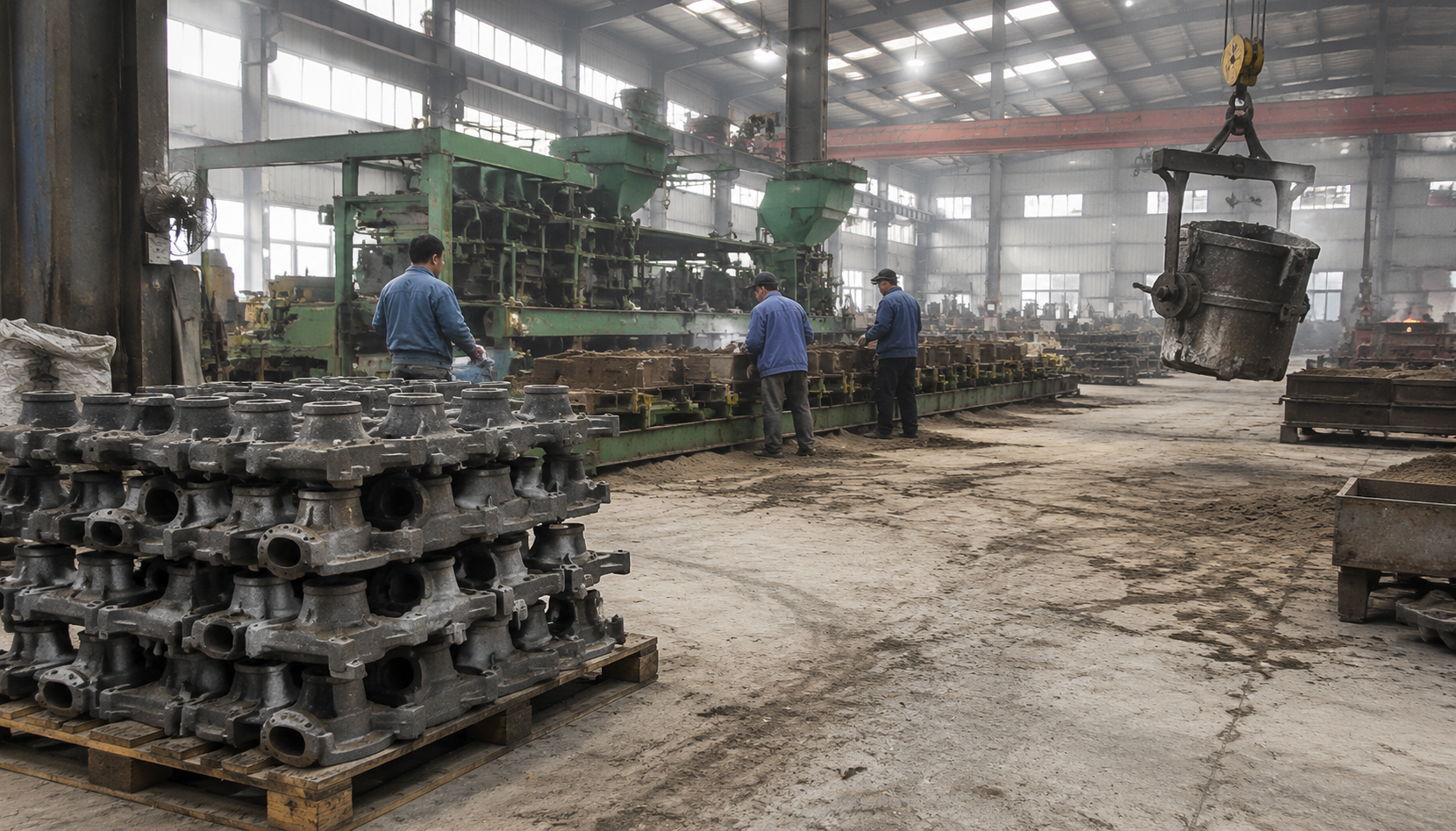
Put the same drawing in front of five foundries and the quotes that come back will spread 40 to 60 percent. Same ASTM A48 Class 30 part, same 500-piece annual volume, same as-cast finish. One lands at $2.15 per kilo, another at $3.40. Nobody in that lineup is trying to rob you.
That spread is the whole problem with a pricelist. It looks like a number. It's actually a set of assumptions about your part, your volume, your tolerances and your documentation — and most of those assumptions aren't printed on the page you're reading.
So here's what a custom cast gray iron pricelist is really telling you, what the line items behind it should be, and how to figure out whether the number in front of you is a bargain or a bill you haven't received yet.
First, the grade question — and why it moves price less than you think
Most buyers assume the grade is the big lever. It isn't. Going from Class 30 to Class 40 on the same part usually adds 5 to 12 percent, because you're tweaking chemistry and sometimes adding a little alloy, not changing the process. What actually moves the number is geometry, cores, tolerance and batch size.
Still, you need the grade right before anything else makes sense. ASTM A48 covers gray iron in classes from 20 through 60, and the class number is the minimum tensile strength in ksi.
| ASTM A48 class | Min. tensile | Where it gets used | Relative price index |
|---|---|---|---|
| Class 20 | 20 ksi / 138 MPa | Bases, covers, grates, counterweights | 1.00 |
| Class 25 | 25 ksi / 172 MPa | General machine frames, low-load housings | 1.00 – 1.03 |
| Class 30 | 30 ksi / 207 MPa | Gear housings, pump bodies, brackets, valve bodies | 1.00 – 1.05 |
| Class 35 | 35 ksi / 241 MPa | Higher-load housings, sheaves, manifolds | 1.04 – 1.10 |
| Class 40 | 40 ksi / 276 MPa | Brake drums, machine tool beds, heavy brackets | 1.06 – 1.15 |
| Class 45 – 50 | 45–50 ksi / 310–345 MPa | Dies, heavy-duty wear parts, press components | 1.12 – 1.25 |
Index values are indicative, based on quotes for comparable 5–20 kg parts. Treat them as a sanity check, not a price list.
One thing worth flagging: if a supplier quotes "gray iron, equivalent to Class 30" without naming a standard, you've got no basis for comparison. ASTM A48, EN 1561 (grades GJL-200, GJL-250, GJL-300) and GB/T 9439 all define different test bar geometries and sampling rules. A Class 30 from one system isn't automatically the other. Ask which standard the tensile test bar is cast to — the answer tells you a lot about how the foundry thinks.
What buyers are actually paying in 2026
There's no published index for custom gray iron castings, so anything resembling a "market price" is assembled from quotes. Here's the range buyers have been reporting this year for Class 30 parts in the 5–20 kg bracket, medium volume, as-cast, no machining:
| Origin | Reported range | Notes |
|---|---|---|
| China (FOB) | $1.10 – $2.00 /kg | Wide spread driven by foundry tier and core count |
| India | $1.40 – $2.30 /kg | Strong on medium-complexity machine parts |
| Vietnam | $1.50 – $2.40 /kg | Thinner supplier base, less price competition |
| Eastern Europe | $1.80 – $3.00 /kg | Short freight to EU, useful for smaller batches |
| US domestic | $3.00 – $6.00 /kg | Competitive for simple, heavy, low-core parts |
| Western Europe | €2.80 – €5.50 /kg | Documentation quality is the differentiator |
Note what those numbers exclude. Machining, coating, testing, tooling, packaging, freight and duty all sit on top. A $1.50/kg casting that needs two machined faces and a primer coat frequently lands closer to $3.20/kg DDP. If you're comparing a $1.50 quote against a $3.20 quote and thinking the second is a rip-off, check what's in each one before you pick up the phone.
The cost breakdown your pricelist should show but doesn't
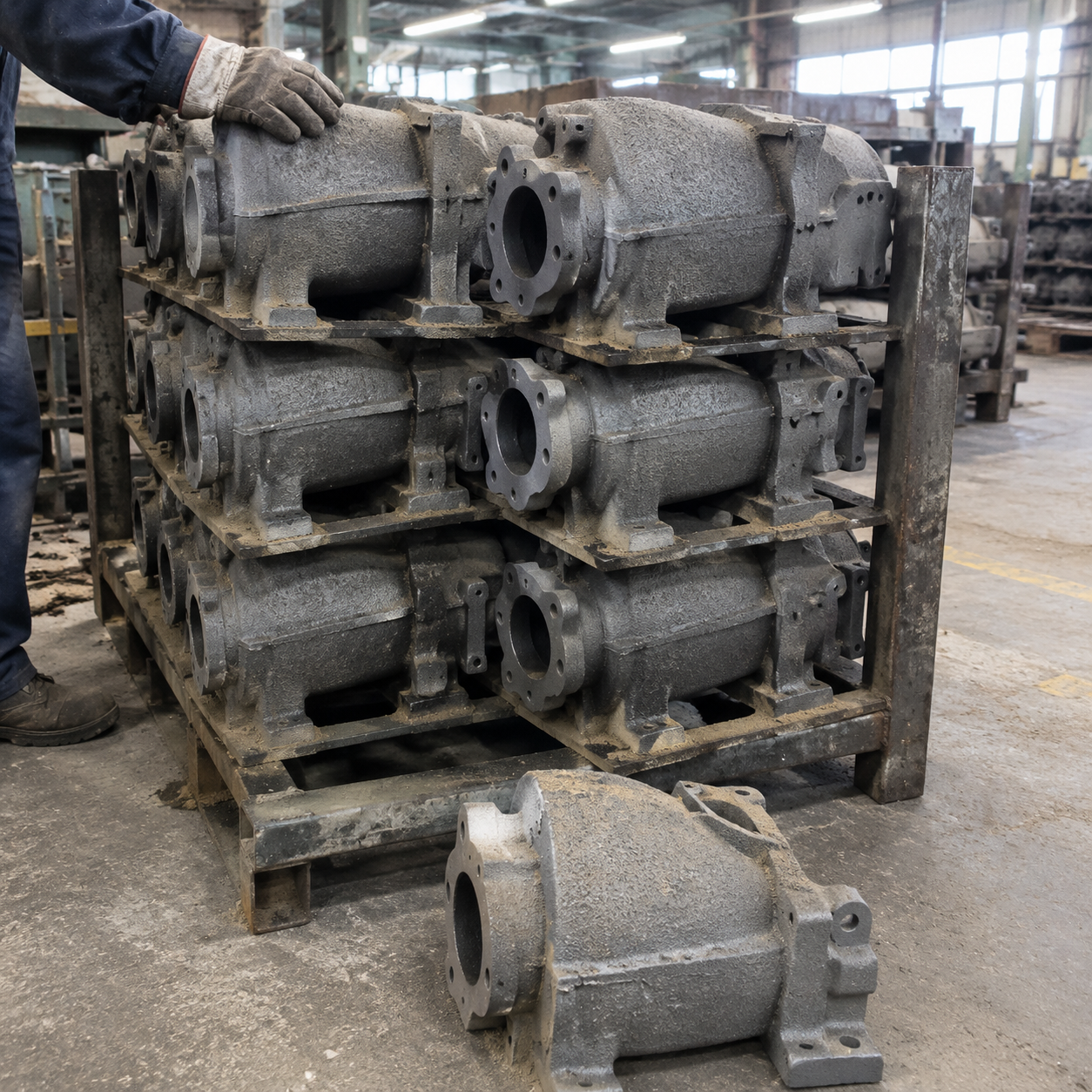
A pricelist gives you one number per part. A real quotation breaks into six sections. If a supplier won't show you those six, you can't tell whether you're comparing the same thing.
Metal charge and melting
Gray iron charge is pig iron, steel scrap and foundry returns, and the metal cost alone usually runs 25 to 35 percent of the part price. Melting energy is the next slice — an induction furnace draws roughly 500 to 600 kWh per tonne, and in a region with high electricity rates that shows up directly. This is also where a low quote often originates: cheaper scrap and less chemistry control. Cheap charge metal is not free. It comes back as slag inclusions and inconsistent hardness six months later.
Gross weight versus net weight — the line nobody explains
Sand casting yield typically runs 60 to 75 percent. That means for every 1 kg of finished part, roughly 1.3 to 1.7 kg of metal gets poured, and the gating system, risers and runners go straight back into the furnace. Most foundries quote on poured weight, not finished weight. That's legitimate — the melting energy was spent either way — but you should know it's happening, because it's one of the places where a 20 percent price gap appears on identical drawings.
If you want to shave cost here, the lever is design: fewer risers, better gating, warmer metal, thinner sections. Foundries that invest in simulation tend to run higher yield and quote lower without cutting anything else.
Tooling
Pattern and core boxes are a one-time charge, but they dominate the first order. For a 5–20 kg part with aluminum pattern equipment, expect somewhere in the range of $3,000 to $15,000 depending on core count and complexity. Two things to nail down before you pay: who owns the tooling, and whether you can take it to another foundry if things go wrong. Get that in writing. Plenty of buyers have discovered mid-dispute that "their" pattern belongs to the supplier.
Machining
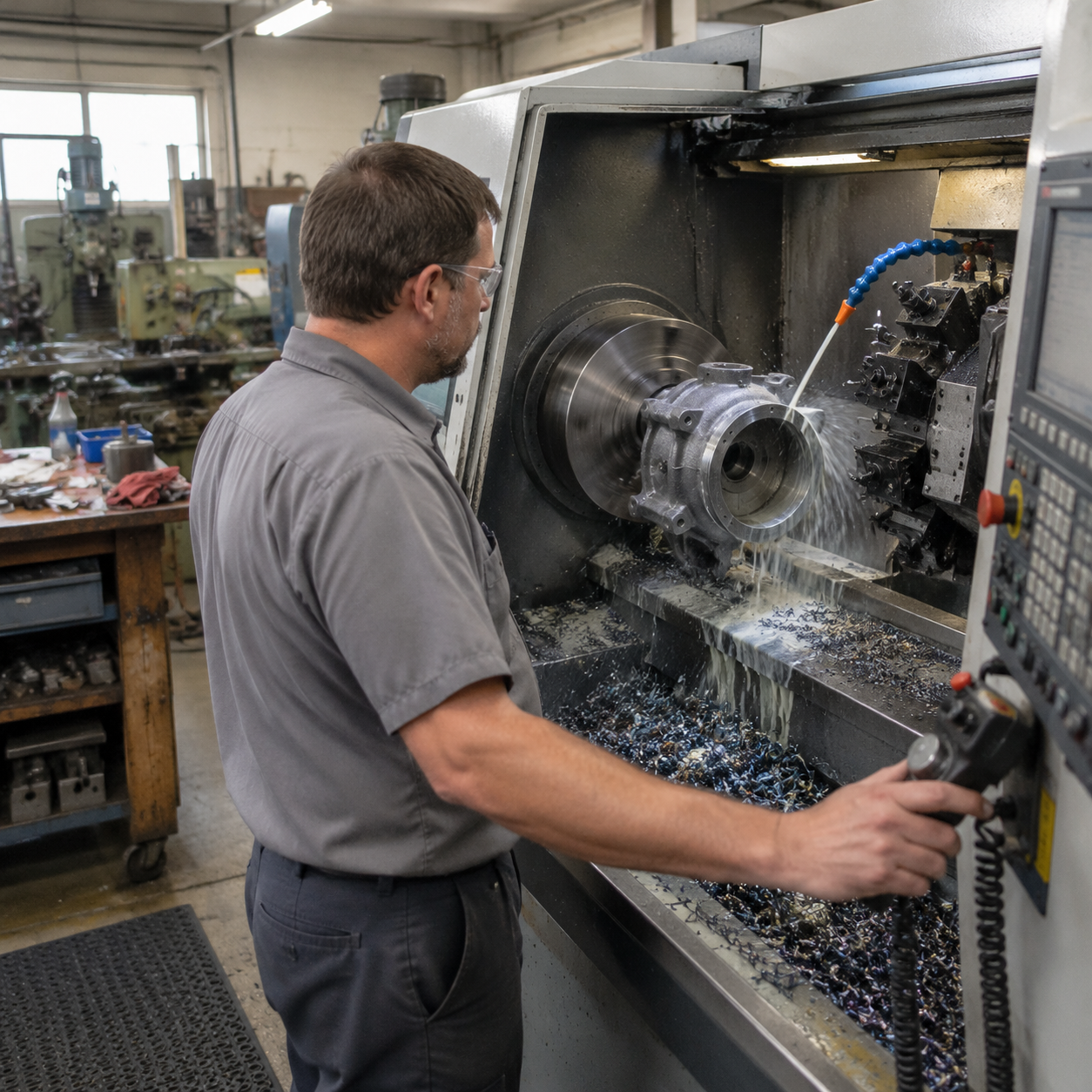
This is the single biggest swing factor after geometry. Machining can be 30 to 50 percent of a finished part price, and hourly rates differ enormously — ballpark $8 to $25 per hour in China, $45 to $85 per hour in the US. A casting with one faced surface and two drilled holes is a very different commercial animal from the same casting with five toleranced datums.
Inspection and documentation
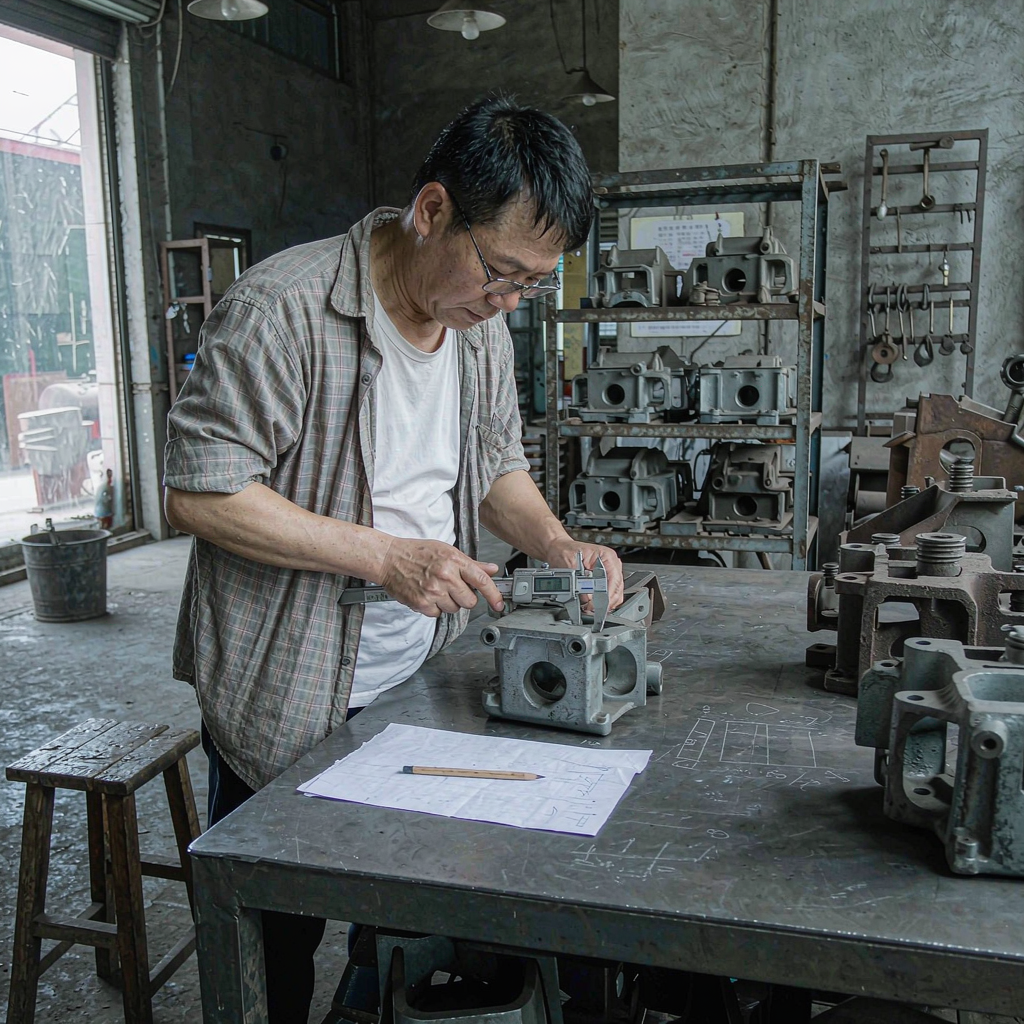
Dimensional reports, tensile testing, hardness mapping, ultrasonic inspection on critical sections, microstructure and graphite classification — each of these costs money and each one shows up differently depending on who you're buying from. This is where a €0.40/kg premium often turns out to be the cheapest part of the order.
Coating, packaging, freight, duty
Primer or paint, export crating with VCI or foam blocking, ocean freight (which has been wildly volatile), and whatever duty rate applies to your origin-destination pair. On tariff exposure: Chinese-origin castings have carried Section 301 duties in the 25 percent range in recent years, with layers changing. Check the current rate before you build a landed-cost model — a quote that looked 30 percent cheaper can evaporate at the port.
Why the lowest pricelist is usually the most expensive order
Run the arithmetic on a 20-tonne order. A $0.40/kg saving is $8,000. Real money, no question.
Now run the other side. One cracked housing that stops an assembly line for a shift, plus the rework, plus expedited air freight for a replacement batch, runs past that $8,000 without breaking a sweat. And that's the best case — the case where you notice before the customer does.
What you're actually buying when you buy cheap in gray iron:
Off-chemistry iron. Carbon and silicon out of range means the graphite flakes change shape, and a part that passed a hardness check at goods-in starts cracking at 8,000 cycles instead of 80,000.
Compromised section thickness. Sand casting tolerances are real, but a foundry chasing yield will push wall thickness to the low side of the range. On a pressure-tight part, that's the difference between passing a leak test and not.
Skipped stress relief. Castings move after machining when residual stress is left in them. Two months down the line, the bolt holes don't line up and nobody can explain why.
Certificates that don't trace. A certificate of conformance is a piece of paper. A certificate of conformance with a heat number that traces back to a furnace log and an actual test bar result is evidence.
None of that shows up on a pricelist.
The document trail to demand before you wire a deposit
This is where the European OEMs are noticeably stricter than the North American mid-market, and it's worth borrowing their habits.
Hans Weber buys castings for a Tier-1 automotive supplier in Bavaria. When asked what he checks first, he didn't hesitate: "I don't look at the price column until I've seen a material certificate with a heat number that traces back to a furnace log. If a supplier can't produce that inside 24 hours, the price is irrelevant. We have had suppliers who could — and suppliers who produced beautiful paperwork the day we asked and nothing on any other day. The second kind is the dangerous one."
That last point is worth sitting with. A supplier who can only produce a traceable certificate when you specifically request it is telling you something about the default state of their quality system.
Here's the minimum package on a custom gray iron order:
Certificate of conformance naming the standard and grade. Chemical analysis per heat covering carbon, silicon, manganese, phosphorus and sulfur. Tensile results from a separately cast test bar, tested to the standard you specified — not to a house standard. Hardness readings from the actual parts. Dimensional report for critical features, with the datum scheme stated. And on anything safety-adjacent, a first article inspection report before volume starts.
For automotive, add PPAP. For pressure-containing parts, add a leak test record and, depending on the application, ultrasonic or radiographic inspection results.
Ask one more question that separates the serious from the rest: who does your tensile testing? In-house lab with a calibrated machine and retained test bars is fine. "We send it out when the customer asks" is a different answer, and you should price that risk in.
The five levers that actually move your price
Forget grade. These are the ones that matter, in roughly descending order of impact.
1. Core count. Every core is another box, another set of handling steps, another chance for a core shift. A part with zero cores and a part with four cores at the same weight are not in the same price bracket. If your design has cores that exist only for a minor weight saving, question them.
2. Tolerance class. ISO 8062 defines casting tolerance grades CT1 through CT16. Sand casting typically lands at CT10–CT11 for dimensional, with CT8–CT9 achievable at a premium. Buyers routinely over-specify here out of caution, then pay for it on every part forever. Specify CT grades only on the features that need them, and let the rest run standard.
3. Wall thickness. Thin sections need hotter pouring, which means more shrinkage porosity risk and more scrap. If a section can be thickened by 2 mm without hurting function, it might pay for itself in yield.
4. Batch size. Setup, pattern handling and machine changeover are fixed costs spread across the run. Going from 200 to 1,000 pieces per release often drops the unit price 15 to 25 percent. Going from 50 to 200 drops it a lot more.
5. Machining allowance and finish spec. Every machined surface adds setup and cycle time. Every tightened surface finish adds a finishing pass. Both are worth auditing against what the part actually does.
What lead time actually looks like in 2026
Pricelists never mention this, and it's half your total cost of ownership.
Pattern and core box fabrication: three to six weeks. First article samples after tooling: three to five weeks. Production run: four to six weeks for sand casting. Machining, if included: add two to three weeks. Ocean freight from Asia to the US or EU: 30 to 40 days door to door, plus customs.
Add it up and a first order runs four to five months from drawing release. Repeat orders compress to roughly 8 to 12 weeks once tooling exists and the process is dialled in.
Two things to ask that a pricelist won't tell you. First, what's their on-time delivery record over the last 12 months, as a percentage — not a description. Second, what happens when a pour fails a tensile test: do they hold the heat, re-test, or ship it and let you find out? The answer to the second question is worth more than a 10 percent discount.
How to get quotes you can actually compare
Most quote comparisons go wrong before the first email reply, because the RFQ didn't say enough. Here's what to include so the numbers land in the same universe:
Drawing with revision level clearly marked. Material specified by standard and grade — "ASTM A48 Class 30", not "gray iron". Annual volume and release schedule, separately — a 5,000-piece annual with 500-piece monthly releases prices very differently from a single 5,000-piece order. Critical dimensions called out, with the CT grade you need on each. Machining scope stated explicitly: as-cast, or finished, and against which datums. Coating and surface finish. Testing and documentation requirements. Packaging and marking. And the Incoterm — FOB, CIF, or DDP, because a $1.50 FOB and a $1.50 DDP are not the same offer.
Then ask each supplier for a cost breakdown by line: metal, melting, molding, finishing, machining, inspection, packaging, tooling. Some will refuse. The ones who refuse and won't explain why are telling you something too.
If you also want to know where the tooling spend sits relative to the rest of your program, it's worth reading up on how casting tooling costs amortise across volume before you commit to a pattern design.
Common mistakes that cost real money
Comparing FOB to DDP. The most common one by a wide margin. It's not a price comparison, it's two different products.
Comparing as-cast to fully machined. Same failure mode, different column.
Leaving tooling out of the unit price comparison. A quote with $12,000 of tooling included in the piece price over 500 units is $24/piece of tooling. One with tooling separate and 2,000 units is $6/piece. The "cheaper" quote may be the more expensive one.
Not specifying tolerance class. Then wondering why the second batch doesn't fit the fixture the first batch fit.
Accepting a house-standard tensile report. If it doesn't reference ASTM A48 or EN 1561 test bar geometry, it's a data point, not a compliance record.
Single-sourcing on price alone. Gray iron is a competitive market. Having a qualified second source costs you nothing at RFQ stage and everything if you don't have one.
Ignoring the crude but useful question: what's their scrap rate? A foundry with a 3 percent internal scrap rate and one with 12 percent will quote differently and deliver differently. Ask. The number is knowable.
Frequently asked questions
How much does custom gray iron casting cost per kg in 2026?
For ASTM A48 Class 30 parts in the 5–20 kg range at medium volume, as-cast and unmachined, buyer-reported ranges run roughly $1.10–$2.00/kg FOB China, $1.80–$3.00/kg Eastern Europe, and $3.00–$6.00/kg from US domestic foundries. Machining, coating, testing and tooling sit on top and can push the landed figure up by 50 to 100 percent.
Why is my quote higher than the foundry pricelist?
Because the pricelist was built against a baseline your part doesn't meet — simple geometry, wide tolerances, few or no cores, as-cast finish, large batch. Everything outside that baseline reappears as a line item. Ask for the breakdown and you'll usually find two or three specific drivers, not a vague premium.
Do I pay for the gating and riser metal that gets remelted?
Usually yes, because most quotations are built on poured weight rather than finished weight. Sand casting yield of 60–75 percent is normal, so 25–40 percent of what you pay per piece is metal that returns to the furnace. It's not a trick, but it is negotiable through design — better gating and fewer risers raise yield and lower your number.
What documents should come with a gray iron casting shipment?
Certificate of conformance, chemical analysis per heat with C, Si, Mn, P and S, tensile results from a separately cast test bar to your specified standard, hardness readings, and a dimensional report on critical features. Automotive and pressure-containing parts need more: PPAP, first article inspection, and leak or NDT records.
How long does a first custom gray iron order take?
Plan on four to five months from drawing release to parts on your dock — three to six weeks of tooling, three to five weeks for first articles, four to six weeks of production, two to three weeks if machining is in scope, and 30 to 40 days of ocean freight. Repeat orders settle around 8 to 12 weeks.
What to do with this before your next RFQ
A pricelist is a starting position. The number that matters is landed cost per good part, and it's built from six line items you now know how to ask for.
So don't send the drawing and wait. Send the drawing with the standard named, the CT grade flagged on the features that need it, the volume split between annual and per-release, the machining scope stated to a datum, and a request for a cost breakdown. Then compare line by line instead of bottom line to bottom line.
If you want a starting point, the 12-point casting RFQ template covers everything above in a form you can drop a drawing into. It also includes the tooling ownership clause language, which is the one thing buyers most often wish they'd written down before paying.
And when a quote comes in 40 percent below the field — get the certificate first. Cheapest part you'll ever buy, or most expensive mistake you'll ever make. The paperwork tells you which.
Need Help with Custom Cast Gray Iron Pricelist: What to Pay in 2026?
Get matched with 3 verified foundries in 24 hours. No markup, transparent pricing.
Request Quotes →