Casting Shipping from China: Costs, Time & 9 Things Buyers Miss (2026)
You found a Chinese foundry that quoted castings at 40% less than your domestic supplier. The quality samples passed. The lead time for production looks good. Then the freight quote lands — and suddenly your margin shrinks by 12%.
Shipping castings from China isn't complicated. But it's full of traps that quietly eat your margin if you don't know what to look for. The freight itself is the easy part. It's the nine things most buyers miss that turn a good deal into a break-even headache.
This guide covers real 2026 freight rates, accurate transit times, and — most importantly — the specific pitfalls that add 10–30% to your landed cost. No fluff. No theory. Just what you need to know before you book that container.
What Casting Shipping Actually Costs (2026 Rates)
Let's start with the baseline. These are real ranges from major Chinese ports (Shanghai, Ningbo, Shenzhen) to common destinations as of Q2 2026. Prices fluctuate by season and fuel costs, but this gives you a solid benchmark.
Sea Freight (FCL — Full Container Load)
| Route | 20-foot container | 40-foot container | Transit time |
|---|---|---|---|
| Shanghai → Los Angeles | $2,800–$4,200 | $4,500–$7,000 | 18–22 days |
| Ningbo → New York | $3,200–$4,800 | $5,200–$7,800 | 28–33 days |
| Shenzhen → Rotterdam | $3,000–$4,500 | $5,000–$7,200 | 30–35 days |
| Shanghai → Hamburg | $2,800–$4,200 | $4,800–$6,800 | 28–34 days |
| Shanghai → Singapore | $1,200–$2,000 | $2,000–$3,200 | 7–10 days |
Rates include basic ocean freight only. Terminal handling, documentation, and customs clearance add $400–$900.
Sea Freight (LCL — Less than Container Load)
If you're shipping smaller volumes — common for first-time buyers or prototype runs — LCL is your option. You pay per cubic meter (CBM) or per metric ton, whichever is greater.
- LCL rate: $85–$160 per CBM, depending on route and volume
- Consolidation fee: $15–$35 per CBM
- Delivery order fee: $60–$120
Pro tip: For castings, LCL has a dirty secret. Your crate gets handled 3–5 times more than FCL. Each handling point is a damage risk. If your castings are machined or have tight tolerances, FCL is worth the extra cost.
Air Freight — When You Absolutely Need It
Air freight for castings? Rarely makes sense unless you're expediting a critical replacement or running low on inventory for a production line. But here's the data:
- Rate: $4.50–$8.00 per kg (depends on density and route)
- Transit: 5–10 days door-to-door
- Minimum charge: Usually $250–$400 per shipment
Run the math: A 300 kg casting shipped by air at $6/kg = $1,800. By sea in LCL: maybe $350. Air is 5x more. Only do it if downtime costs more than the freight premium.
Express Rail (China → Europe)
A middle ground that's gaining traction. The China-Europe rail route (Chongqing to Duisburg, for example) takes 15–20 days and costs about 50–70% of air freight.
- Rate: $2,500–$4,000 per container (20-foot)
- Best for: Castings destined for Central or Eastern Europe
- Catch: Limited capacity and subject to geopolitical scheduling changes
Shipping Timelines: What to Expect (and What Delays You)
The standard narrative — "sea freight takes 4 weeks" — is incomplete. Here's the real breakdown from factory door to your receiving dock.
| Stage | Typical duration | What can go wrong |
|---|---|---|
| Export customs clearance | 2–3 days | Incorrect HS code or missing document → 5–10 day delay |
| Port loading & vessel departure | 2–5 days | Missed sailing window → wait for next vessel (3–7 days) |
| Sea transit (US West Coast) | 18–25 days | Weather, port congestion, or rerouting |
| Sea transit (US East Coast) | 28–35 days | Panama Canal draft restrictions add 2–5 days |
| Sea transit (Europe) | 28–35 days | North Sea weather delays in winter |
| Import customs clearance | 2–5 days | Random inspection or valuation hold → 7–14 days |
| Inland delivery | 2–5 days | Chassis shortage or trucking capacity |
Reality check: The "sea freight takes 4 weeks" claim really means 6–7 weeks door-to-door in most cases. Plan for it. If you're buying castings for a production line, add 2 weeks of buffer to whatever your supplier quotes.
9 Things Buyers Miss (That Quietly Eat Your Margin)
This is the section that'll save you money today. Every one of these traps has burned real buyers. I've seen each one personally. Don't let them catch you.
1. Peak Season Surcharges — The $1,500 Surprise
Every year, August through October, ocean carriers slap on peak season surcharges (PSS) of $500–$1,500 per container. Buyers who lock in quotes in June get a nasty surprise when the invoice arrives in September. Ask upfront: "Is this rate valid through my shipping window, or will PSS apply?"
2. Port Congestion Fees — You Pay for Their Problem
When ports get congested — and they will, especially Los Angeles/Long Beach or Rotterdam — carriers pass on congestion surcharges. These range from $200 to $1,000 per container and appear with zero warning. Your freight forwarder should flag this in their quote. If they don't, find a new forwarder.
3. Packing Material Eats Your Volume
You calculated 18 cubic meters of castings. Perfect for a 20-foot container (which holds ~28 CBM). Then the foundry adds plywood crates, foam dividers, steel strapping, and pallets. Your actual volume hits 23 CBM. Suddenly you're paying for a 40-foot container or squeezing parts. Rule of thumb: Add 15% to your net casting volume for packaging. Confirm with the foundry before you book.
4. Insurance Gap — $0.50/kg Coverage Is a Joke
Standard carrier liability is roughly $0.50 per kilogram. On a $15,000 casting shipment weighing 500 kg, that's $250 coverage. If a crate falls off a forklift and your investment is destroyed, you're eating $14,750. Marine cargo insurance at 0.3–0.5% of cargo value is a rounding error compared to the risk. Don't skip it.
5. Document Errors — The 7-Day Delay for a Typo
One wrong HS code on the commercial invoice. One missing "material test certificate" for a specialty alloy. A bill of lading that doesn't match the packing list. Any of these can trigger a customs hold that lasts 7–14 days. Meanwhile, your demurrage clock is ticking. Solution: Send all documents to your customs broker 5 days before the vessel arrives. Have them pre-validate.
6. HS Code Misclassification — Paying More Duty Than You Should
Castings fall under different HS codes depending on material and application. Iron castings (HS 7325), steel castings (HS 7326), aluminum castings (HS 7616) — each has a different duty rate. Classify wrong, and you either overpay duty or trigger a customs audit. Get a customs broker who specializes in metal goods. Not all brokers know the difference between ductile iron and gray iron for tariff purposes.
7. Demurrage & Detention — The Daily Bleed
You get 3–5 free days at the destination port before demurrage kicks in. After that, it's $50–$150 per container per day. If customs delays your clearance by 4 days, that's $600 you didn't budget. Same for detention on the chassis — $75–$200 per day. Always include a demurrage/detention line item in your freight quote so you know the daily cost upfront.
8. Weight Surcharges — LCL's Hidden Tax
LCL freight is charged on "chargeable weight" — the greater of actual weight (per metric ton) or volumetric weight (per CBM). Castings are dense. Your 1 CBM crate of steel castings might weigh 3,000 kg. The volumetric calculation at 1 CBM = 1,000 kg means you pay for 3 CBM. Always ask: "What's the chargeable weight basis for this LCL quote?"
9. Last-Mile Delivery — The Quote That Didn't Include the Truck
Your freight quote says "$3,200 to New York." Great. But that's port-to-port. Getting the container from the port to your warehouse in New Jersey or Ohio costs another $300–$800 depending on distance and chassis availability. And if your receiving dock doesn't have a loading dock for a 40-foot container? Now you're paying for a liftgate truck or a remote delivery. Clarify incoterms and delivery scope before you book.
Packaging Requirements for Castings
Packaging is one of the most under-budgeted line items in casting shipping. Here's what actually works.
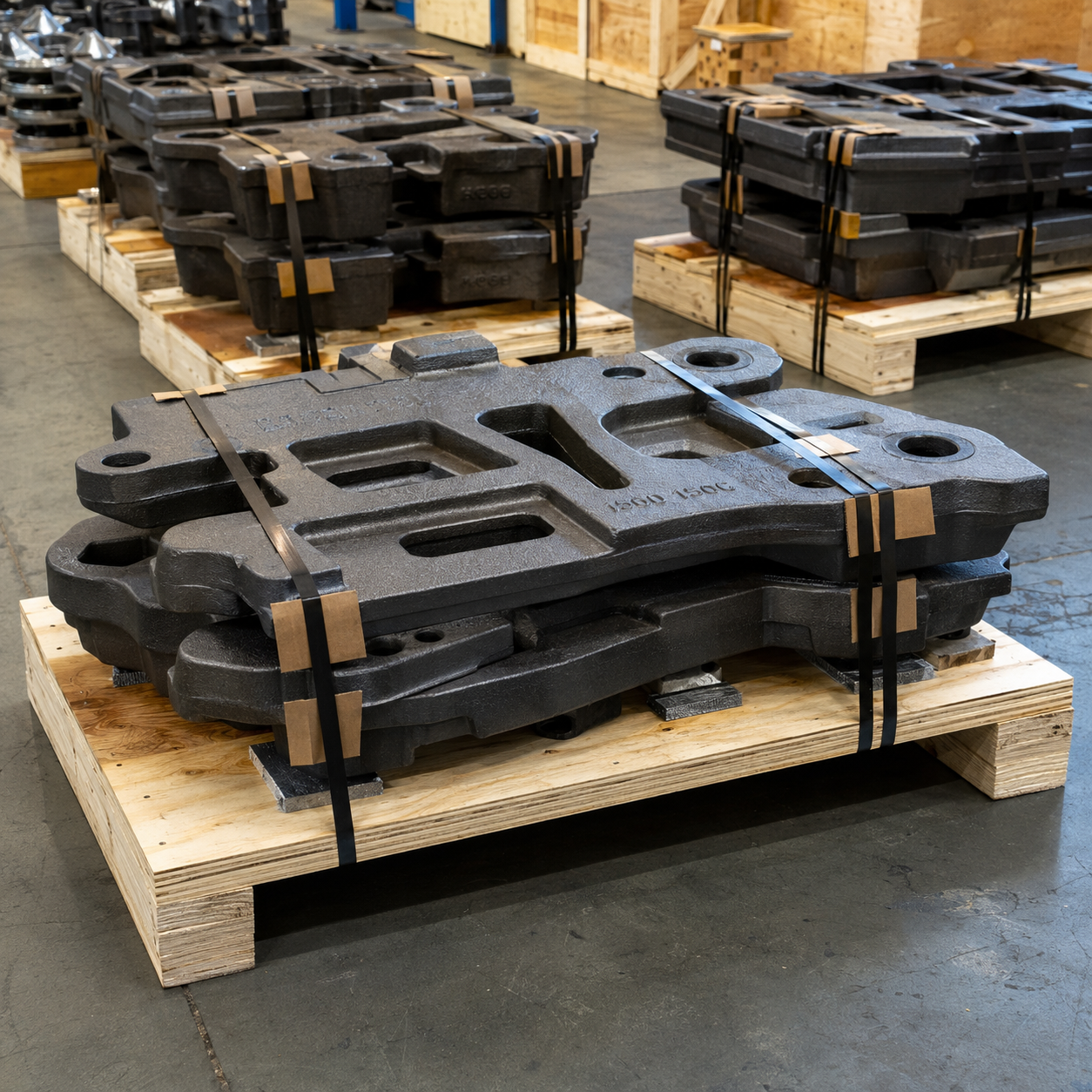
Heavy Castings (over 50 kg each)
- Bolt or weld to steel or plywood skids — never loose in a container
- Use steel strapping with edge protectors (not plastic — it snaps in transit)
- Add rubber mats or vibration-dampening pads between layers
- Each skid should have a center of gravity mark and lifting points
Small to Medium Castings (under 50 kg)
- Plywood crates with internal foam dividers or corrugated cardboard separators
- If using cardboard boxes, double-wall corrugated minimum, with full overlap
- Each layer separated by 10mm foam or corrugated sheet
- Crates should be stackable — the export crates from China often aren't designed for container stacking loads
ISPM-15: The Certification You Can't Skip
All wooden packaging material — pallets, crates, skids — must be ISPM-15 heat treated and stamped with the IPPC logo. If your foundry ships on untreated wood, the destination country will fumigate it (at your cost) or reject the shipment. Verify the ISPM-15 stamp before the container leaves the factory. A photo takes 10 seconds and saves you a $500 fumigation bill.
Insurance: Why the Standard Coverage Is a Trap
Here's a real scenario: A buyer named Tom shipped $42,000 worth of machined ductile iron castings from Qingdao to Houston. The container got a saltwater spray during a storm. The castings surface-rusted. Standard carrier liability paid Tom $1,200. His actual loss: $41,000 plus 8 weeks of production delay.
Marine cargo insurance for that shipment would have cost Tom around $170 (0.4% of cargo value).
Do the math on every shipment. If your cargo value exceeds $5,000 and the insurance cost is under 1% of value, it's a no-brainer. Most freight forwarders can arrange it. If they can't, use a dedicated cargo insurer like TT Club or through your freight forwarder's broker network.
Documentation Checklist — Don't Leave Port Without These
One missing document = one delayed shipment. Here's your complete list:
| Document | Who provides it | Why you need it |
|---|---|---|
| Commercial Invoice | Foundry | Customs valuation & duty calculation |
| Packing List | Foundry | Weight, volume, and package count verification |
| Bill of Lading (or Airway Bill) | Carrier | Title of goods and shipping contract |
| Certificate of Origin | Foundry or CCIC | Tariff preference & trade agreement eligibility |
| Export Customs Declaration | Foundry's customs broker | Legal export clearance from China |
| Material Test Certificate (MTC) | Foundry | Chemical composition & mechanical properties proof |
| ISPM-15 Certificate | Packaging supplier | Wood packaging treatment compliance |
| Insurance Certificate | Insurer | Proof of cargo insurance coverage |
Pro tip: Create a digital folder shared with your foundry and your customs broker 10 days before the vessel arrives. Give all three parties view access. Flag any mismatch between the commercial invoice and packing list — even a 10 kg weight discrepancy can cause a customs hold in some countries.
FCL vs LCL: Which One for Your Castings?
Quick decision framework:
- Under 10 CBM: LCL is your only practical option. But double-box fragile castings.
- 10–18 CBM: Borderline. Price both options. LCL might be cheaper on paper, but factor in higher damage risk and slower transit (LCL gets consolidated and deconsolidated).
- Over 18 CBM: FCL, always. Lower per-unit cost, faster transit, less handling.
One more thing: If your castings are high-value or precision-machined, FCL is worth it even at 12 CBM. The damage reduction alone pays for the container premium.
Frequently Asked Questions
How long does casting shipping from China take?
Sea freight to the US West Coast takes 18–25 days; to the East Coast 28–35 days. Express rail to Europe takes 15–20 days. Air freight takes 5–10 days but costs 4–6x more. Door-to-door, add 7–12 days for customs clearance and inland delivery.
What does it cost to ship castings from China?
A 20-foot container runs $2,500–4,500, a 40-foot container $4,000–7,500 depending on port and season. LCL costs $80–150 per cubic meter. Air freight is $4–8 per kg. Add $400–900 for terminal handling, documentation, and customs clearance.
How should castings be packed for ocean freight?
Castings over 50 kg should be bolted to plywood or steel skids with steel strapping. Smaller parts go in plywood crates with foam dividers. All wooden packaging needs ISPM-15 heat treatment certification. Add 15% to your net volume for packaging.
Do I need insurance for casting shipments from China?
Yes. Standard carrier liability covers roughly $0.50 per kg. For a $15,000 casting shipment, that's maybe $300 coverage. Marine cargo insurance at 0.3–0.5% of cargo value is highly recommended.
What documents are required to clear castings through Chinese customs?
You need: commercial invoice, packing list, bill of lading (or airway bill), certificate of origin, and an export customs declaration. For specialty alloys, add a material test certificate. Missing one document can delay your shipment by 7–14 days.
Should I use FCL or LCL for casting shipments?
If your casting volume exceeds 15 CBM, FCL is almost always cheaper per unit and safer. LCL works for smaller loads but carries higher damage risk due to more handling. For fragile or precision-machined castings, FCL is strongly recommended even at lower volumes.
What are common hidden costs in casting shipping from China?
Peak season surcharges ($500–1,500), port congestion fees ($100–1,000), demurrage and detention fees ($50–150 per day), documentation amendment fees ($50–200), and customs inspection fees ($200–600). These can add 10–30% to your base freight cost. Always ask for a full breakdown upfront.
How can I reduce casting shipping costs from China?
Three strategies: (1) Consolidate shipments — one 40-foot container costs only 50–70% more than a 20-foot but carries 2x+ volume. (2) Ship during off-peak months (February–May, November) to avoid peak season surcharges. (3) Use a freight forwarder who specializes in metal goods — they know the HScodes and avoid reclassification fees.
What incoterm should I use for casting shipments?
For experienced buyers: FOB (Free on Board) gives you control over freight pricing. For first-time buyers: CIF (Cost, Insurance, Freight) simplifies things — the foundry handles shipping to destination port. But CIF quotes often include a 10–20% markup on freight. Get a standalone freight quote to compare.
Next Steps — Ship Your Castings Without the Surprises
Shipping castings from China isn't a mystery. It's a process with known costs, known timelines, and known traps. The buyers who get burned are the ones who treat shipping as a "last detail" instead of a core part of the procurement plan.
Here's your checklist before you book your next shipment:
- ✅ Get a full freight quote with all surcharges itemized
- ✅ Confirm ISPM-15 certification on all wood packaging
- ✅ Pre-validate all export documents with your customs broker
- ✅ Buy marine cargo insurance at 0.3–0.5% of cargo value
- ✅ Add 15% volume buffer for packaging
- ✅ Budget 2 weeks of buffer on the shipping timeline
You've done the hard part — finding a quality foundry and negotiating fair casting prices. Don't let shipping surprises eat your hard-earned margin. Know the costs. Plan for the traps. Ship smart.
Need a freight forwarder who actually understands castings? Talk to our logistics team — we handle 200+ casting shipments a year and know the traps inside out.
Need Help with Casting Shipping from China: Costs, Time & 9 Things Buyers Miss (2026)?
Get matched with 3 verified foundries in 24 hours. No markup, transparent pricing.
Request Quotes →