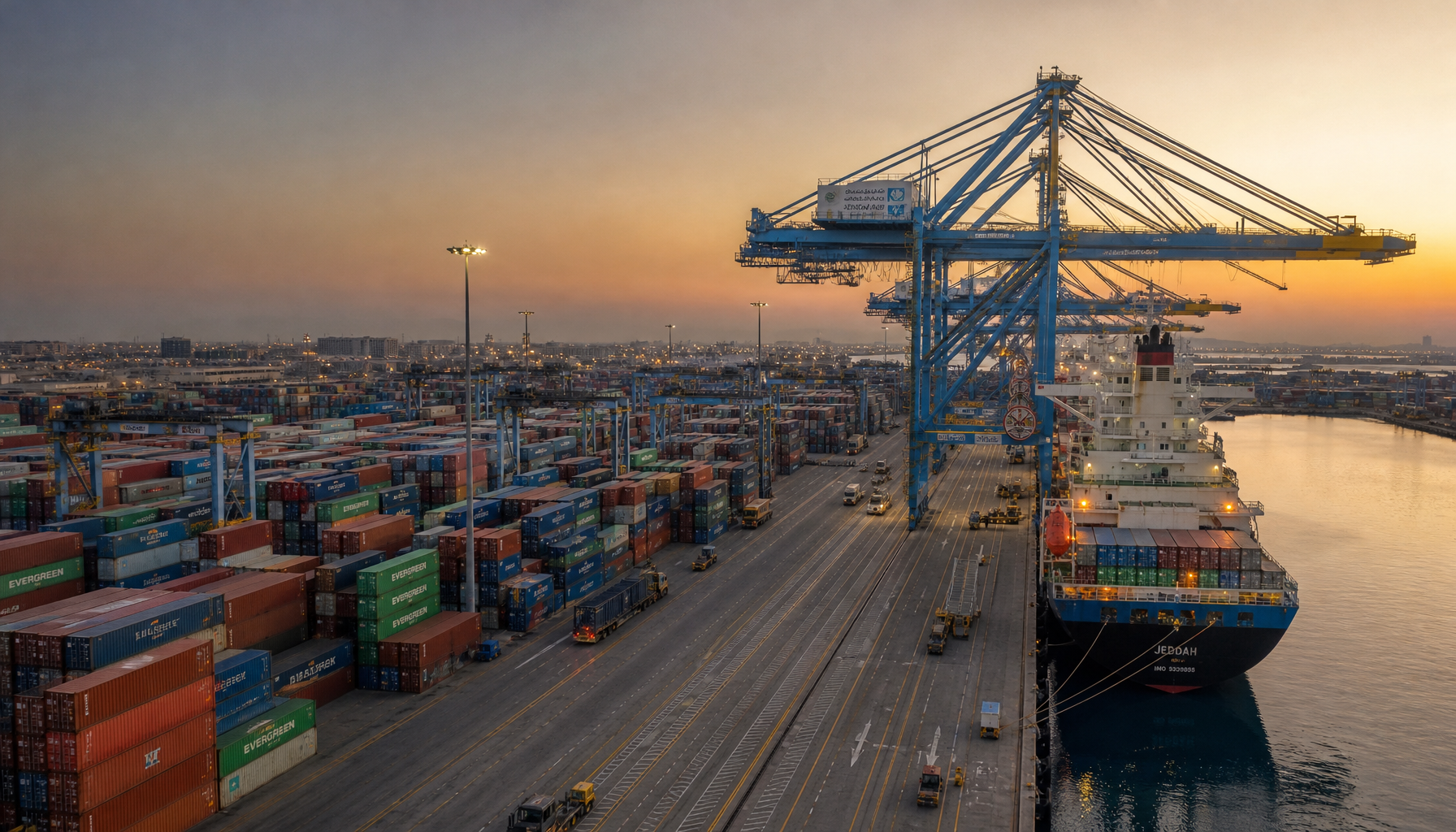
A 40-foot container of ductile iron valve bodies leaves Qingdao on the 14th. It docks at Jeddah Islamic Port on the 22nd. The importer's broker files the customs declaration the next morning. By the 24th, the container is flagged — no Shipment Certificate matched to the commercial invoice. It sits for nineteen more days. Storage charges run to roughly SAR 6,000, the EPC contractor pushes a commissioning date by a week, and the foundry gets an angry email about "quality issues" that have nothing to do with quality.
None of that was a casting problem. It was a paperwork problem, and it's the single most common way Saudi-bound shipments die.
Saudi Arabia imported roughly $280 billion worth of goods in 2024. Somewhere between $4 and $6 billion of that was cast and forged metal — pump housings, valve bodies, manhole covers, automotive knuckles, pipe fittings, crusher wear parts. Around 20% came from China, with India, Germany, and Turkey splitting most of the rest.
Here's the part nobody quotes in a trade stat: a meaningful slice of those containers sat at Jeddah or Dammam for two to six weeks after arrival. Not because the castings were bad. Because the paperwork wasn't.
Saudi Arabia runs one of the tightest conformity regimes in the Gulf. Since the SABER platform went mandatory, there's no "we'll sort it out at the port" option anymore. Either your product certificate and shipment certificate exist before the vessel lands, or your goods don't move.
This guide walks through what the Kingdom actually requires in 2026 — the regulators, the certificates, the HS codes, the document pack, and the specific mistakes that strand shipments. Realistic timelines, real cost ranges, and where a supplier can pre-empt the delays before they happen.
Saudi Arabia's casting market by the numbers
Worth understanding why demand is climbing before you worry about compliance.
- Vision 2030 targets manufacturing at roughly 20% of non-oil GDP by the end of the decade, up from around 12% when the plan launched. That means new plants, and new plants need castings.
- Saudi domestic foundry capacity is thin. The Kingdom produces well under 1 million tonnes of castings a year against a global output of roughly 110 million tonnes (estimated, American Foundry Society baseline). Everything else is imported.
- Construction and water infrastructure alone account for a large share of ductile iron pipe fittings, valve bodies, and manhole covers coming through Dammam and Jeddah.
- Iron and steel imports into the GCC have run in the 15–20 million tonne range annually in recent years, with Saudi Arabia taking the largest single share.
Translation: there's real, durable demand for castings. The bottleneck isn't the market. It's clearing the conformity wall.
Three regulators, one cleared container
Every casting shipment into Saudi Arabia passes through three gates. Miss any one and the container stops.
SASO — the standard-setter
The Saudi Standards, Metrology and Quality Organization defines which technical standards apply to your product. For castings, SASO largely adopts GSO standards, which are in turn harmonized from ISO and EN. An EN-GJL-250 grey iron casting that satisfies ISO 185 in Europe will usually satisfy the Saudi equivalent without engineering changes. What matters is documentation, not redesign.
SABER — the platform
SABER is the online system where conformity certificates are issued and matched to shipments. It replaced the old paper Certificate of Conformity scheme. Two documents come out of it: a Product Certificate (PC) and a Shipment Certificate (SC). We'll get into both in detail below.
ZATCA — the customs authority
The Zakat, Tax and Customs Authority handles duty assessment, valuation, and physical release. ZATCA won't release a container without a valid SC linked to the declaration. It also applies the GCC common external tariff and, where applicable, safeguard duties. Valuation is based on the transaction value of the goods, CIF — and if ZATCA's own reference pricing suggests the invoice is materially below comparable imports, they will revalue.
One more regulator to keep on your radar: SFDA if any casting touches food or potable water contact surfaces, and MOT if you're supplying automotive safety components. Both add their own conformity layer on top of SASO. For water-works castings — a huge slice of Saudi imports — the SFDA layer is not a formality, it's a hard gate.
SABER explained: PC vs SC
This is where most first-time exporters lose money. The two certificates do different jobs.
Product Certificate (PC)
A PC applies to a product type from a specific manufacturer. It's valid for one year and covers unlimited shipments within that window, as long as the product and the manufacturing site don't change.
To get one, the Saudi importer submits:
- Product technical data — drawings, material grade, dimensions, application
- Test reports from an accredited laboratory (ISO/IEC 17025)
- Manufacturer's quality system certificate — ISO 9001 at minimum
- Factory name, address, and production site details
- Product photos and HS code classification
The certification body reviews the file, may request additional testing, and issues the PC through SABER. Realistic timeline for industrial castings: 5–15 working days once the file is complete.
Shipment Certificate (SC)
An SC is issued per shipment. Each container load gets its own. It links the specific commercial invoice, packing list, and bill of lading to the underlying PC.
Typical turnaround is 1–3 working days — but only if the PC is current and the invoice details match exactly. Mismatch a single part number and you're back to the queue.
Who can apply
Only a Saudi-registered importer holding a valid Commercial Registration can hold a SABER account. As the exporter, you cannot apply directly. You supply the technical file; your buyer or their customs broker does the filing.
This trips up first-time sellers constantly. If your buyer has never imported before, or their CR doesn't cover the product category, no certificate gets issued — no matter how good your castings are. Screen your buyer's import credentials before you quote, not after.
What it costs
Estimates, because pricing varies by certification body and product risk category:
- PC: roughly SAR 1,500–5,000 ($400–1,335) per product family
- SC: roughly SAR 300–900 ($80–240) per shipment
For a buyer running regular monthly shipments across three product families, that's a few thousand dollars a year amortized across the volume. Cheap compared to a stranded container. Ask your buyer who is paying before you agree a delivered price — this is one of the most common surprises in first-year Saudi orders.
Which technical standard applies to your casting
This is where a supplier's competence shows. Vague answers about "international quality standards" don't survive a SABER review.
What you need on file:
- The exact standard your buyer declared. If the PC says the valve body is tested to a GSO standard, your mill certificate must name the same standard. Don't assume equivalence — document it.
- Material grade traceability. Heat number on the casting, heat number on the mill certificate, heat number on the test report. Three-way match, or the file gets bounced.
- Mechanical test results. Tensile strength, yield, elongation, hardness — tested from a separately cast test bar or from the casting itself, depending on the standard.
- Chemical composition. Full spectrum analysis from an accredited lab, not an in-house spectrometer printout.
- Non-destructive testing records where the application requires it — radiography, ultrasonic, magnetic particle, dye penetrant.
- Heat treatment records if the casting is normalized, quenched, or tempered. Time, temperature, and furnace chart.
For pressure-retaining castings — valve bodies, pump housings, pipe fittings — expect the certification body to ask for hydrostatic test results and, in some cases, a burst test report. Budget for this. It's not optional and it's not something you can backfill after the shipment books.
Practical rule: if you can't produce a four-page technical file for a single casting part number within 72 hours, you're not ready to quote Saudi Arabia.
The document pack your Saudi buyer needs
Assemble this before the vessel sails. Every item below has caused a held container at least once.
1. Commercial invoice
Needs to match the SABER declaration line for line — description, quantity, unit price, total value, HS code. Saudi customs also expects the invoice to state the country of origin explicitly, not just the port of loading. Watch for the classic error: goods made in China but shipped from a Singapore consolidator, invoice reads "Origin: Singapore." That's a red flag and a delay.
Some product categories still require legalization through a Saudi embassy or consulate. Most castings don't — a chamber attestation is normally enough. Confirm with your buyer's broker before you assume either way.
2. Packing list
Per-package detail: number of pieces, gross weight, net weight, dimensions, package type. If your castings ship on pallets with strapping and edge protection, list it. Physical inspection at the port compares the packing list to what's on the dock.
3. Bill of lading
Consignee must be the Saudi importer whose CR is tied to the SABER account. If the BL names a third party in Dubai or a trading company, expect questions. This is the single most common mismatch that blocks SC issuance.
4. Certificate of Origin
Issued by your local chamber of commerce, then attested. Must match the invoice exactly on description and quantity. Saudi Arabia applies the GCC common external tariff, and origin determines whether any preferential treatment applies. For most Chinese, Indian, and Turkish castings, there's no FTA in play — you pay the standard rate.
5. Product Certificate (PC)
The valid PC covering this product type. Keep a PDF copy with the shipping documents.
6. Shipment Certificate (SC)
Issued per shipment and linked to the specific invoice. No SC, no clearance.
7. Material test reports and inspection certificates
Mill certificates to EN 10204 3.1 or equivalent, lab test reports, NDT records, heat treatment charts. Your buyer may not need to hand all of these to customs, but they'll need them for the PC file and for their own quality records.
8. Third-party inspection certificate
Not always mandatory, but if your buyer's specification calls for SGS, BV, TÜV, or Intertek witnessing, the certificate needs to be issued pre-shipment. You cannot retroactively inspect goods sitting in a container at Jeddah.
HS codes and what you'll actually pay
Most finished castings land at the GCC common external tariff of 5% ad valorem. That's the headline number. Here's the detail behind it.
| HS Code | Description | Standard Rate |
|---|---|---|
| 7325.10 / 7325.99 | Other cast articles of iron or steel | 5% |
| 7326.11 / 7326.19 | Other articles of iron or steel | 5% |
| 7616.99 | Other articles of aluminium | 5% |
| 8481.80 | Taps, cocks, valves and similar appliances | 5% |
| 8413.91 | Parts of pumps | 5% |
Two things on top of the duty:
- VAT at 15%. Saudi Arabia raised VAT from 5% to 15% in July 2020. It applies to the customs value plus duty. If your buyer is VAT-registered and importing for their own business, they can typically recover it — but they pay it at clearance.
- Safeguard duties. Saudi Arabia has applied safeguard measures on certain steel products. Finished castings under HS 7325 are generally outside the scope, but semi-finished and long steel products are not. Get your 8-digit classification confirmed before you quote a delivered price.
Customs valuation is based on the transaction value of the goods, CIF. If the invoice looks artificially low compared to comparable imports, ZATCA will revalue. Under-declaring to save 5% duty is a fast way to trigger a full audit and a much larger problem.
Marking, labeling, and Arabic requirements
Physical compliance gets checked too. Three points that cause friction:
Country of origin marking
Castings need a legible, permanent country of origin mark. Not a sticker on the pallet — a mark on the part itself or on the packaging in a way that survives handling. Cast-in marks, engraved marks, or stamped marks all work. Ink-jet on a shrink film does not.
Arabic on labels and documentation
Saudi labeling rules require Arabic for consumer-facing products. Industrial castings sold B2B have more latitude, but packaging labels and any accompanying instructions should carry Arabic alongside English. If your buyer is end-supplying a government project, expect this to be enforced strictly.
Packaging for climate and handling
Jeddah runs hot and humid year-round. Machined surfaces that ship unprotected will arrive with surface rust. VCI wrapping, desiccant, and proper edge protection aren't optional for Saudi-bound castings — and visible corrosion at inspection time invites a quality hold on top of the compliance review.
Seven mistakes that strand containers at Jeddah
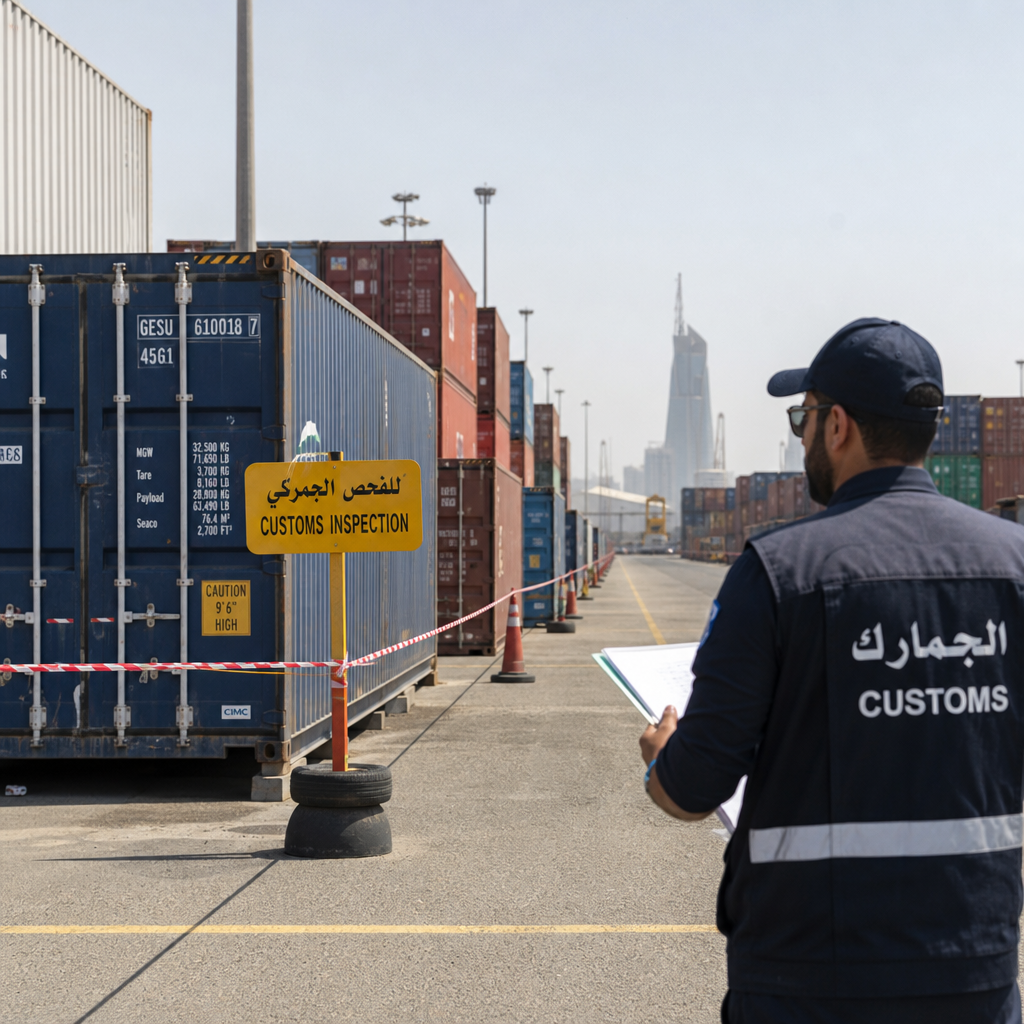
Compiled from patterns that show up over and over in Gulf-bound casting shipments.
- No PC before vessel departure. Buyers book the shipment first and chase the certificate later. The container arrives, no SC can be issued, and storage costs start ticking after the free window — typically 5–7 days, then roughly SAR 150–300 per container per day (estimated).
- Invoice and SABER declaration don't match. Different part numbers, different quantities, different descriptions. Even a spelling variation on a material grade can trigger a resubmission.
- Consignee name mismatch on the BL. The BL names a trading company; the SABER account belongs to a different legal entity. Fix it before departure, not after.
- Expired ISO 9001 certificate. The certification body checks your quality system certificate validity date against the shipment date. A lapsed certificate kills the PC application.
- Test reports from a non-accredited lab. In-house spectrometer printouts won't pass. Reports need to come from an ISO/IEC 17025 accredited laboratory.
- Wrong HS code at the 8-digit level. A pump housing classified as a finished pump, or a valve body classified as a complete valve, changes both the duty rate and the conformity pathway.
- Assuming the buyer knows the process. Plenty of Saudi importers are new to SABER, or their broker is. If nobody on the buying side owns the compliance timeline, you should. Send a document checklist with the quotation.
Timeline: from quote to cleared goods
A realistic schedule for a first casting shipment into Saudi Arabia:
- Week 0: Buyer confirms CR covers the product category and opens a SABER account
- Weeks 1–2: Technical file compiled — drawings, test reports, ISO 9001, photos
- Weeks 2–4: PC application submitted and reviewed; certification body may request additional testing
- Weeks 4–8: Production, pre-shipment inspection, packing
- Week 8: Vessel departs; SC application filed against the invoice and BL
- Weeks 9–12: Arrival, customs declaration, duty and VAT payment, release
Start the PC process in parallel with production, not after it. The certificate's one-year validity makes this painless — you front-load the work once and then every subsequent shipment only needs an SC. Buyers who do this once typically see customs clearance shrink to 3–5 days on repeat orders.
FAQ
Can an overseas foundry apply for a SABER certificate directly?
No. Only a Saudi-registered importer with a valid Commercial Registration can hold a SABER account and apply for a PC or SC. You provide the technical file; your buyer or their customs broker files it.
How long does a SABER Product Certificate take to issue?
5–15 working days for most industrial castings, once the technical file is complete. The two most common delays are missing material test reports and an expired ISO 9001 certificate.
What is the customs duty on castings imported into Saudi Arabia?
Most finished castings under HS 7325, 7326, and 7616 pay the GCC common external tariff of 5% ad valorem, plus 15% VAT on the customs value. Some steel products carry safeguard duties on top — verify your exact 8-digit code with a Saudi broker.
Does the commercial invoice need consular legalization?
Usually not for castings. A chamber-attested invoice is normally accepted. A limited number of categories still require embassy or consulate legalization, so confirm with your buyer's broker rather than assuming.
What happens if the shipment arrives without a Shipment Certificate?
It can't clear. The container is held at the port and accrues storage charges until an SC is issued, or the goods are re-exported or destroyed. Retroactive issuance is only possible if the goods haven't been released and the underlying PC is still valid.
Do I need Arabic labels on industrial castings?
For B2B industrial castings the enforcement is lighter than for consumer goods, but Arabic alongside English on packaging labels and instructions is the safe default — especially if the goods feed into a government or Aramco-linked project.
Next steps
Before you send a single quotation to a Saudi buyer, run these four checks:
- Confirm the buyer's CR covers your product category and that they can open a SABER account.
- Get the target HS code confirmed at the 8-digit level by a Saudi customs broker — not guessed from a lookup site.
- Assemble the technical file: drawings, accredited lab reports, ISO 9001, heat treatment records, NDT where applicable.
- Agree in writing who owns the PC application, who pays for it, and what happens if it's rejected.
Get those four right and the rest of the process is administrative. Skip them and you'll learn the Saudi conformity regime the expensive way — one container at a time.
Need Help with Casting Export to Saudi Arabia: 2026 Import Requirements?
Get matched with 3 verified foundries in 24 hours. No markup, transparent pricing.
Request Quotes →