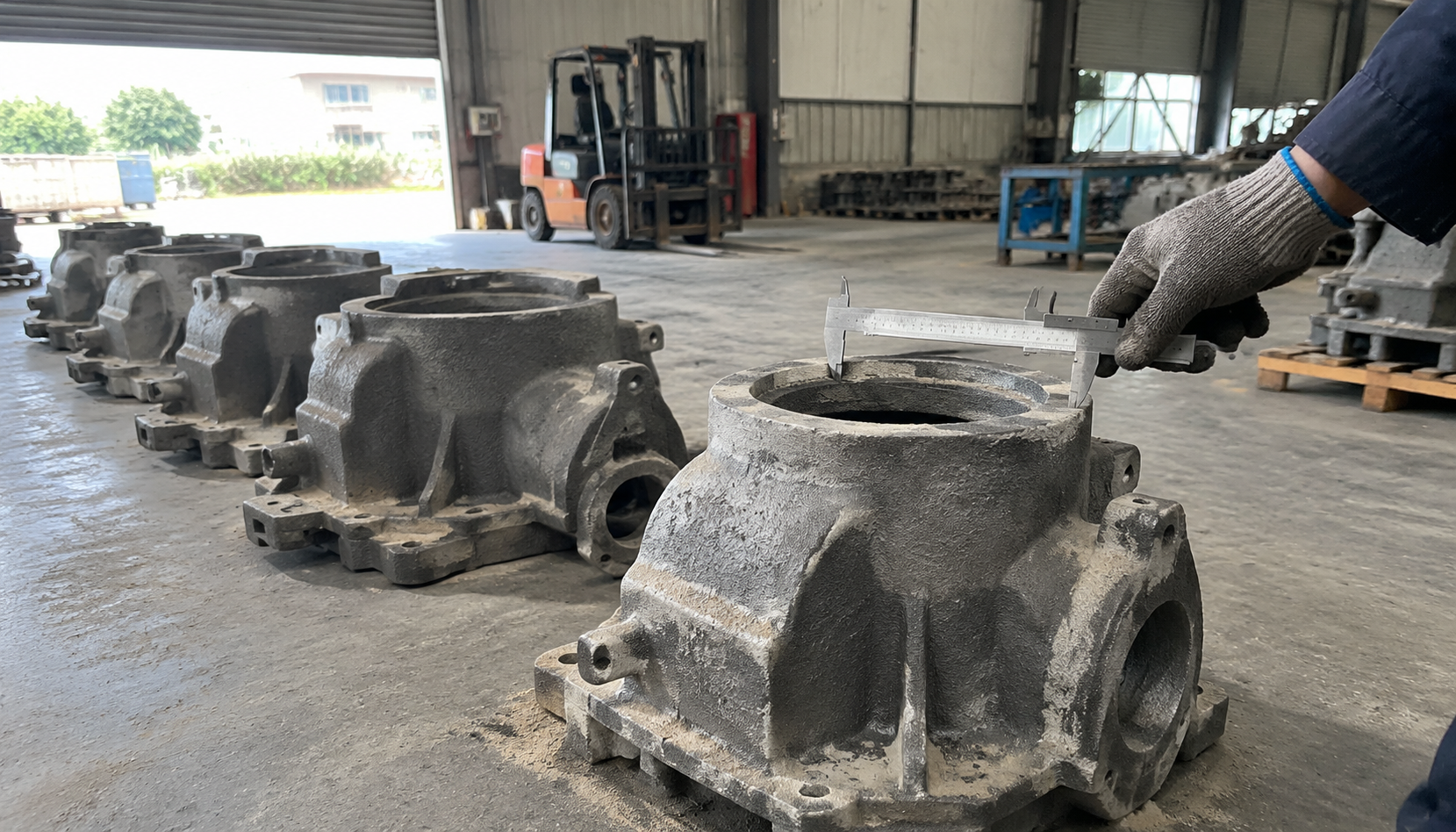
In September 2026, an Ohio purchasing manager sent the same gray iron housing drawing to eleven suppliers.
Three countries. Five process routes. One identical 2D drawing. When the quotes came back, the spread between the highest and lowest was 61%.
That gap wasn't fraud. It was information asymmetry. The cheap quote used a different grade than the drawing specified. The expensive one baked in a machining allowance nobody asked for. Two of the eleven "pricelists" weren't price lists at all — they were a single number per kilogram with no basis stated, no weight class, no validity date.
So let's fix that. Here's what gray iron actually costs in 2026, sorted by weight, grade and process. And here are the line items a real pricelist has to expose before you can compare it to anything.
Start With the Metal: What a Foundry Pays Before It Quotes You
Gray iron pricing floats on two commodities. Get them wrong and every number downstream drifts.
As of mid-October 2026, Chinese domestic pig iron (foundry grade, 18#) is trading around RMB 3,850–4,050 per tonne ex-works in Hebei, and heavy steel scrap sits at RMB 2,600–2,750 per tonne. These are foundry purchasing quotes and market spot assessments; treat them as a working range, not a tick-by-tick fix. Convert at 7.15 and you're looking at roughly USD 545/t of pig iron and USD 370/t of scrap.
A typical HT250 (GG25) charge mix on the shop floor runs about 55–65% pig iron, 25–35% steel scrap, and the rest returns from the foundry's own risers and rejects. Do that math and the raw metal in your casting costs somewhere between USD 0.42 and USD 0.55 per kilogram before a single arc is struck.
That's the floor. Everything above it is melting energy, molding, labor, yield loss, overhead, margin and freight.
In our quote benchmarks across a few hundred gray iron inquiries, metal cost typically lands at 45–60% of the final piece price. That's a working range, not a precise figure — yield and scrap mix swing it. When someone quotes you USD 0.85/kg for an HT250 casting in a 15 kg weight class, they're telling you the foundry is working for free — or that the grade isn't HT250. Both are worth knowing before you place a trial order.
Rule of thumb worth memorizing, drawn from pattern-shop economics: if the metal content alone is 50% of the quote, the foundry has room to run a clean heat. Under 40%, you're buying a foundry's margin problem — and those get paid back in yield games and inspection shortcuts within two production runs.
The Actual Pricelist: USD per Kg, FOB China, Q4 2026
Below is a benchmark table drawn from quotes on medium-volume orders (500–5,000 pcs per line item), clay-bonded sand molding, painting excluded, machining excluded, standard packaging onto pallets. The ranges reflect real spread from Hebei, Shandong and Jiangsu foundries in Q3–Q4 2026 — not a single shop's rate card.
Base casting price by weight class
| Finished weight per piece | Clay sand (green sand) | Resin-bonded sand | Shell / coated sand |
|---|---|---|---|
| 50–200 kg | USD 1.00–1.30 | USD 1.15–1.50 | USD 1.40–1.85 |
| 10–50 kg | USD 1.20–1.55 | USD 1.35–1.80 | USD 1.65–2.15 |
| 2–10 kg | USD 1.55–2.05 | USD 1.70–2.30 | USD 2.05–2.70 |
| 0.3–2 kg | USD 2.05–2.85 | USD 2.25–3.15 | USD 2.70–3.80 |
Weight class matters more than most buyers expect. A 0.5 kg bracket and a 120 kg machine base can use the identical grade, the identical chemistry, and the identical labor hours per tonne — yet the bracket costs more than twice as much per kilogram. Why? Because you're paying for handles, flask cycles, per-piece inspection time, and the fact that a bad 120 kg casting is one scrap event while a bad 0.5 kg casting is one of forty in the same mold.
Grade uplift: HT200 through HT350
Higher tensile grade means more steel scrap in the charge, tighter carbon equivalent control, more inoculation discipline, and usually a higher rejection rate. The market prices that in.
| Grade (GB/T 9439 / ISO 185) | Approx. ASTM A48 equivalent | Uplift vs HT200 | Typical min. tensile |
|---|---|---|---|
| HT200 / GG20 | A48 Class 30 | Baseline | 200 MPa |
| HT250 / GG25 | A48 Class 35 | +USD 0.06–0.10/kg | 250 MPa |
| HT300 / GG30 | A48 Class 40 | +USD 0.14–0.20/kg | 300 MPa |
| HT350 / GG35 | A48 Class 45–50 | +USD 0.24–0.34/kg | 350 MPa |
One caution on that table: GB/T 9439, ISO 185 and ASTM A48 do not line up perfectly. HT250 specifies 250 MPa minimum tensile on a 30 mm test bar; A48 Class 35 specifies 35,000 psi (241 MPa) on a separately-cast test bar with different geometry and a different chemistry window. When a supplier says "equivalent," ask which standard the actual test will follow, and put it on the drawing. The cross-reference above is a purchasing approximation, not a metallurgical equivalence claim.
If your drawing says HT300 and the quote is priced like HT200, you've found your answer without asking another question. Ask for the heat analysis on the first article. A real HT300 heat will show chromium or molybdenum additions, or at minimum a carefully controlled Mn/S ratio and a carbon equivalent held around 3.6–3.8.
Machining, Coating and the Add-Ons That Double Your Invoice
The casting price is rarely the price you pay. Here's what gets attached to it, with realistic 2026 numbers.
Machining
Simple face milling, drilling and tapping on a 10 kg housing typically adds USD 0.45–1.10/kg on top of the raw casting. It also adds lead time — usually 7–15 days on top of a 30–45 day casting cycle — and it moves quality liability to the machining supplier. Complex multi-face work with tight positional tolerance can push the adder past USD 1.80/kg, at which point it's worth asking whether the casting itself is being over-engineered.
Ask any machining supplier one question: what is your scrap rate on this part number, and who eats it? If they say 0.5%, and their price is 30% above the shop next door, the shop next door is eating 8% quietly.
Surface treatment
- Primer only (shop coat): USD 0.08–0.15/kg
- Powder coating: USD 0.25–0.50/kg, plus a cure cycle
- E-coat / electrophoretic: USD 0.30–0.55/kg, best for internal surfaces
- Shot blasting (Sa 2.5): USD 0.06–0.12/kg
Note that shot blasting is often quoted as "included" and then quietly omitted. Look at the first container. If the parts arrive with sand crust on the parting line, you bought a raw casting, not a blasted one.
Tooling
Pattern equipment for gray iron runs USD 1,800–4,500 for a simple single-cavity pattern in a 10–50 kg weight class, up to USD 12,000–30,000 for a multi-cavity resin pattern on a complex part. Tooling is a one-time charge, but it has a second life: when you switch suppliers, the pattern usually can't walk out the door with you.
Ask who owns the pattern at the end of the PO. Ask it in writing. Foundries that answer "you do, and we'll release it in a crate" are the ones you want. Foundries that dodge are telling you something.
China vs India vs Vietnam vs the US: Same Part, Four Price Lists
The table below assumes an HT250 / A48 Class 35 equivalent, 8 kg bracket, 2,000 piece annual volume, clay sand, unmachined, FOB origin port.
| Origin | Piece price (USD/kg) | Tooling | Lead time | Sea freight to US East Coast |
|---|---|---|---|---|
| China (Hebei / Shandong) | 1.35–1.70 | USD 2,200–3,800 | 35–50 days | USD 0.09–0.14/kg |
| India (Coimbatore / Rajkot) | 1.45–1.85 | USD 2,000–3,500 | 40–55 days | USD 0.11–0.17/kg |
| Vietnam | 1.55–2.00 | USD 2,600–4,200 | 45–60 days | USD 0.10–0.15/kg |
| US domestic (Midwest) | 3.20–4.60 | USD 6,000–14,000 | 20–30 days | — |
The US line is not a mistake. Domestic gray iron foundry capacity has thinned for two decades, and what's left is booked solid on hydraulic and municipal work. If your part is 8 kg, non-safety-critical, and you can live with a 6-week ocean leg, the arithmetic is not close.
But — and this matters — the US line wins on one thing the table can't show: change management. When your engineer revises a core print on a Tuesday, a Midwestern shop can be cutting a modified pattern by Friday. Almost nothing offshore can do that. If your part is still in development, price the domestic shop first and accept it.
Why Two Quotes for the Same Drawing Differ by 40%
Walk through the actual line items. Six of them explain almost every outlier.
1. Charge mix and the scrap-price bet
Foundries buy scrap on spot and sell castings on a quarterly index. Some quote aggressively hoping scrap drops; others pad defensively. Ask for the metal index basis written into the pricelist — a good one reads something like "base price valid at scrap index USD 370/t; adjusts ±0.6% per USD 10/t movement." A pricelist with no index clause isn't a price, it's a mood.
2. Yield and riser design
A casting that weighs 8 kg may come from a 14 kg pouring weight. That 43% yield is priced into the piece. Two foundries can achieve 43% and 61% on the same part through different riser and gating design — and the difference shows up directly in your per-kg number. If a quote is 25% under the field, ask what yield they assumed.
3. Sand system cost
Green sand molding is cheap and forgiving. Resin-bonded sand delivers better dimensional control at roughly 20–30% higher cost. If two quotes differ by that exact margin, you're probably looking at different molding routes, not different margins.
4. Inspection scope
Visual + dimensional sampling: essentially free. Dimensional report per piece: real money. Radiography, ultrasonic, hardness mapping, metallographic section on every lot: prices itself in fast. Get the inspection plan itemized, then delete what you don't need. Most buyers over-specify inspection on gray iron because they carried the spec over from a ductile or steel part where it mattered more.
5. Packaging
Bulk in a pallet box: USD 0.02/kg. Individually bagged, labeled, and packed in a fitted carton: USD 0.18–0.40/kg. On a 500-piece run of an 8 kg part, that difference is USD 720 to USD 1,600. Check whether the quote says "export packing" or actually describes a box.
6. Payment terms
A quote at 30% T/T deposit and 70% against B/L copy carries a different price than one demanding 100% before shipment. Suppliers price in their financing cost. If you're comparing a 100% prepay quote to a 30/70 quote, subtract roughly 1.5–3% from the prepay number before comparing — that's the financing you're effectively providing.
The Nine Things a Pricelist Must Show Before You Compare It
Print this. Hand it to whoever sends you a one-line-per-kg spreadsheet.
- Grade and standard. "Gray iron" is not a grade. You want HT250 per GB/T 9439, or A48 Class 35, or GG25 per DIN 1691 / ISO 185. Named, on the page — and with the test standard the certificate will follow, because those three don't line up perfectly.
- Molding process. Green sand, resin-bonded, or shell. The process sets dimensional tolerance, surface finish, and tooling life — and it explains 20–30% of the price gap between two shops that both say "sand casting."
- Price basis. FOB which port? Ex-works? CIF? A CIF price to Los Angeles and an FOB Shanghai price are not comparable, and the freight leg alone can swing 8–12%.
- Metal index clause. Base index value and the adjustment rate. Without it, the price is valid until the next email.
- Weight class breakpoints. Price per kg must change with piece weight. A flat per-kg rate across a 0.5 kg to 100 kg range is a guess dressed as a price.
- Volume tier. 500 / 2,000 / 10,000 pcs. Note the step-downs. If there are none, the supplier has no idea what their own setup cost is.
- Cost breakdown. Not the full BOM, but a workable split: metal, melting energy, molding, fettling, inspection, packing, margin. A supplier who can't produce this doesn't understand their own cost stack — and you'll be the one funding the gap.
- Inclusions and exclusions. Exactly what's included — molding, melting, fettling, shot blast, primer, inspection, packing. Everything else is an extra.
- Validity date. Anything past 60 days on a commodity-linked product is fiction. Thirty to forty-five days is normal.
Where Buyers Get Burned: Five Mistakes That Cost Real Money
Mistake 1: Comparing per-kg prices across different machining states
The most common error, and the most expensive. An unmachined quote at USD 1.45/kg against a machined quote at USD 2.10/kg looks like a 45% saving. It isn't — you're comparing a casting to a finished part. Normalize first, then compare.
Mistake 2: Assuming low price means low grade
Sometimes it does. Sometimes it means the foundry has a better yield on your specific geometry, or runs a larger furnace with cheaper per-tonne energy. The way to find out is the heat analysis on the first article, not the price. Request the spectrometer printout with the first shipment and compare it to the grade spec. Costs you nothing. Catches the problem immediately.
Mistake 3: Not pricing the pattern twice
Your first LOA might include USD 2,800 of tooling. Your second LOA — same part, different supplier, two years later — will include tooling again, because the first pattern stayed with the first foundry. Build the tooling amortization into a 3-year cost model instead of treating it as a one-time line item.
Mistake 4: Specifying HT300 when HT250 will do
Go back to the drawing. Is the 300 MPa specified because the FEA required it, or because someone copied a template? On a non-structural housing, HT250 at 250 MPa with proper section thickness is often generously adequate. That single grade change is worth USD 0.14–0.20/kg — on a 500-tonne annual program, USD 70,000–100,000 a year.
Mistake 5: Ignoring the freight-weight issue
You pay freight on the casting's shipping weight, including draft, machining allowance and any riser stubs left for the machining supplier to remove. On a 10 kg finished part that can be 11.5 kg of freight. Over an annual program that's real. Ask for the shipping weight per piece in the quote, not the finished weight.
What You Can Actually Negotiate, and What You Can't
Ranked by how much movement you'll realistically get on a first order.
| Lever | Realistic movement | Notes |
|---|---|---|
| Packaging simplification | 5–15% of total | Easiest win, zero quality risk |
| Inspection scope trim | 2–8% | Requires engineering sign-off |
| Grade downgrade (if justified) | 5–12% | Biggest single lever, needs FEA or test data |
| Volume commitment (12-month LOA) | 4–9% | Foundries discount forward visibility heavily |
| Payment terms (30/70 vs 100% prepay) | 1.5–3% | Trade financing for price, usually worth it |
| Metal price (per-kg base) | 0–4% | Very sticky; foundries are already thin |
| Tooling cost | 0–10% | Only on repeat tooling at the same shop |
The lever with the most room is not the per-kg number. It's the specification. Grade, packaging and inspection scope together routinely account for 12–30% of landed cost — and unlike price haggling, tightening them actually makes your supply chain more predictable.
FAQ
What is a fair price per kg for gray iron castings in 2026?
For clay-sand HT250 in a 10–50 kg weight class, FOB China, USD 1.20–1.55/kg is the working band. Below USD 1.05/kg, check the grade and the yield assumption. Above USD 1.80/kg, check what's bundled in that you didn't ask for.
Why is my quote per kilogram higher than a competitor's flat rate?
Because the flat rate is almost certainly wrong for your weight class. Per-kg cost on gray iron falls sharply as piece weight rises — a 0.5 kg part and a 100 kg part cannot honestly share a rate. A supplier quoting one number for everything is quoting an average and will lose money on half the range.
Should the pricelist include a metal index clause?
Yes, and it protects both sides. Without one, the foundry carries all commodity risk and prices it in defensively — you pay a premium for insurance you didn't want. A base index plus a stated adjustment rate is the professional version.
How much should gray iron tooling cost?
USD 1,800–4,500 for a simple single-cavity pattern in a mid-weight part, USD 12,000–30,000 for complex multi-cavity resin tooling. Anything dramatically cheaper usually means a soft pattern that will wear out inside 5,000 shots.
Is HT250 the same as ASTM A48 Class 35, or GG25?
Close but not identical — and this is where a lot of sourcing disputes start. HT250 under GB/T 9439 specifies 250 MPa minimum tensile on a 30 mm test bar. ASTM A48 Class 35 specifies 35,000 psi (241 MPa) on a separately-cast test bar. GG25 under DIN 1691 / ISO 185 is its own chemistry window again. The test bar geometry and carbon equivalent limits differ across all three. A supplier switching standards must confirm equivalence on the drawing, not assume it — and state which standard the certificate will report.
Can I get a pricelist without a drawing?
Not a meaningful one. Anything you receive without a drawing is a generic band, useful only for a ballpark. Real numbers require weight, grade, wall thickness, core count, machining state and annual volume. Supply all six and a competent foundry can price within 8% in three days.
What to Do Next
Take the pricelist you're holding right now and run the nine-point check above. Count how many of the nine items are actually on the page. Most lists score three or four.
Then do this: send the supplier three questions in one email.
- What grade and standard does this price assume, stated on the drawing — and which test standard will the certificate follow?
- What metal index is the base price valid at, and what's the adjustment rate?
- What is the shipping weight per piece, and what does "packing" specifically include?
You'll get a fast, definitive read on who's pricing properly and who's guessing. The suppliers who answer all three with numbers in the same email are the ones worth putting on your shortlist — regardless of where their per-kg line sits.
And if a quote comes back 30% under the field with no explanation of yield, no index clause, and a flat per-kg rate across every part you sent — treat it as a question, not an answer. It's the cheapest question you'll ever ask.
Need Help with Best Cast Gray Iron Pricelist 2026: Real USD/kg Rates, Grade by Grade?
Get matched with 3 verified foundries in 24 hours. No markup, transparent pricing.
Request Quotes →