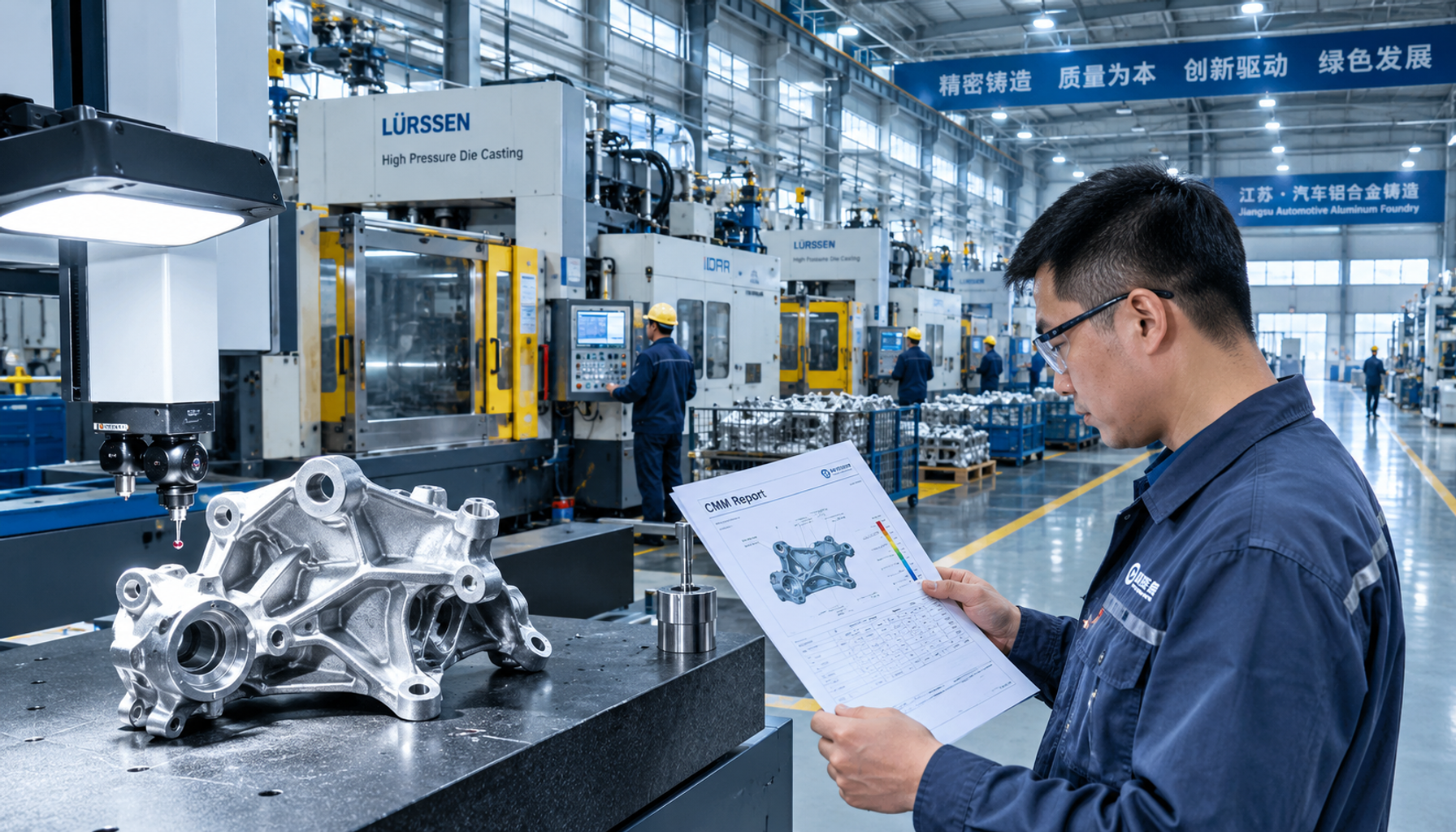
Your PPAP came back rejected. Third submission. The casting passed dimensional check, the material cert matched spec, and the CMM report was clean. But the FMEA your foundry sent reads like a template pulled off a competitor's website, the control plan lists a frequency that doesn't match what's actually happening on the shop floor, and your customer's SQE wants a written explanation by Friday.
If you buy castings for the automotive supply chain, that scenario isn't unusual. IATF 16949 is not an optional badge in this industry. It's the entry ticket. But the gap between a foundry that holds a certificate and one that actually runs to the standard is enormous, and that gap is where launches slip, warranty claims pile up, and sourcing careers get shortened.
This guide covers what IATF 16949 actually demands from a casting supplier, which supporting standards apply to metal casting specifically, and what to check before you sign anything. No fluff, no sales pitch. Just the checklist you wish someone had handed you before your first overseas casting program.
IATF 16949 in One Paragraph (and Why It Doesn't Say What You Think It Says)
IATF 16949:2016 replaced ISO/TS 16949 in October 2016. It is a quality management system standard, not a product standard. That distinction matters. It doesn't tell your foundry what tolerance to hold on a bore or what alloy to pour. It tells them how their organization (their processes, their documentation, their people, their corrective actions) must be structured to reliably produce parts that meet your drawing and your customer's requirements.
Technically, IATF 16949 sits on top of ISO 9001:2015. Same clause structure, same PDCA backbone. What it adds is automotive-specific meat: control plans linked to PFMEAs, mandatory statistical process control on designated characteristics, MSA on measuring systems, PPAP on every new part, and a hard requirement to cascade quality requirements down to sub-suppliers.
Certification runs on a three-year cycle with annual surveillance audits. Roughly 90,000 sites are certified worldwide, and the registrars are not equally rigorous. A certificate from a credible body means something. One from a body that runs audits over video call and never sets foot on the shop floor means almost nothing. Look past the logo on the letterhead.
One more thing: certificates are scoped. A foundry might be certified for machining and assembly but not for "casting of aluminum alloys," which means the foundry's core process, the one that actually makes your part, isn't covered by the certificate. Read the scope statement, then go see whether it matches the process you're buying.
The Five Core Tools—and Where Foundries Usually Fail
Anyone who has spent time in automotive quality knows the acronym set: APQP, PPAP, FMEA, MSA, SPC. AIAG publishes them; VDA mirrors them for the German OEM world. Every IATF-certified supplier is required to apply all five. In practice, foundries handle the first three with varying competence and the last two poorly.
APQP: Advanced Product Quality Planning
APQP runs five phases from concept through production validation. Phase 3, process design and development, is where casting suppliers consistently under-deliver. Tooling design, process flow, PFMEA, and control plan are all supposed to be built out in detail here. What many foundries actually submit is a two-page flow chart and a PFMEA recycled from a different part family.
If your program involves a complex casting, whether that's a thin-wall aluminum structural part, a high-pressure die cast housing with tight porosity limits, or a heat-treated ductile iron safety component, ask to review Phase 3 deliverables before tooling is cut. If the PFMEA doesn't mention the failure modes your part is actually exposed to (cold shut, gas porosity, shrinkage, hot tearing, distortion during heat treat), the plan is decorative.
PPAP: Production Part Approval Process
PPAP is the submission package that proves a supplier can consistently produce parts to spec at the quoted rate. Eighteen elements, five submission levels. The levels are broken out further down. For now, understand this: PPAP is not a one-time formality. It must be re-run after any design change, process change, tooling change, location change, or sub-supplier change, and after any extended production break (typically 12 months, unless your customer specifies otherwise).
A foundry that treats PPAP as a one-and-done document is a foundry that will hand you a nonconforming lot after they move the die to a different press without telling you.
FMEA: Failure Mode and Effects Analysis
The AIAG-VDA FMEA Handbook (first edition 2019, updated 2020) replaced the old RPN ranking with Action Priority (AP: High, Medium, Low). What that means for a casting buyer:
- The PFMEA must list casting-specific failure modes, not generic manufacturing ones.
- Detection ratings must reflect the inspection method actually used. "Final inspection" is not a detection control.
- High-AP items must show evidence of action taken, such as a revised control method. A note that says "monitor" is not evidence.
- The PFMEA must feed the control plan. If the two documents don't walk the same process steps in the same order, the audit will catch it.
MSA: Measurement System Analysis
MSA validates that the measurement system can detect variation that matters. The usual study is Gage R&R. For castings, the typical failure isn't the math, it's the setup. Suppliers run Gage R&R on a smooth machined reference part instead of a raw casting with draft angles, parting lines, and as-cast texture. The study passes. The gauge still doesn't measure your part.
Ask for Gage R&R studies on the same features your drawing flags as Key Characteristics, run on parts that match production conditions. Anything above 30% is a red flag. Between 10% and 30% may be acceptable depending on the characteristic and the customer requirement, but it needs justification in writing.
SPC: Statistical Process Control
SPC requires that significant characteristics be monitored with control charts, and that out-of-control conditions trigger documented reactions. The foundry failure modes here: charts that get filled in but never acted on, control limits calculated once in 2019 and never updated, and initial process studies that vanish after PPAP approval.
At PPAP, initial process capability (Ppk) is normally evaluated on 300 consecutive parts per the AIAG PPAP manual, unless your customer specifies otherwise. Typical acceptance thresholds:
| Characteristic type | Typical Ppk requirement |
|---|---|
| Safety / regulatory (S, CC) | ≥ 1.67 |
| Significant (SC) | ≥ 1.33 |
| Non-designated | No formal study required, but process must be stable |
In mass production, those shift to Cpk. A foundry that passes Ppk at launch but drifts below 1.33 Cpk by month six is showing you an unstable process that passed on a good day.
Casting-Specific Standards You Actually Need to Reference
IATF 16949 is the management layer. The technical layer is a stack of international standards that define what a good casting is. For automotive work, you'll see these named on the drawing or the purchase specification, and they are not interchangeable.
Dimensional tolerance
- ISO 8062-3 — the international system for castings dimensional tolerances and machining allowances. Uses DCTG grades 1–16 for dimensional tolerance and GCTG grades for geometric tolerance. Loose sand casting typically lands around DCTG 9–12. High-pressure die casting sits around DCTG 4–6. Your drawing should specify the grade, and the grade should match the process you're buying.
- VDG P690 — the German foundry industry's tolerance standard for die casting. Common on Tier-1 drawings out of Germany and Austria.
- NADCA product standards — North American die casting tolerance tables.
Material and microstructure
- ASTM B26 / B108 — aluminum sand and permanent mold castings. A356.0 / A356.2 are the workhorses for structural and safety parts.
- ASTM B85 / B94 — aluminum die casting alloys (A380, A383, ADC12 equivalents).
- EN 1706 — aluminum casting alloys under the European system (EN AC-46000, EN AC-43400, etc.).
- ISO 185 / ISO 1083 — grey iron and spheroidal graphite (ductile) iron.
- ASTM A536 — ductile iron for automotive applications, grades 60-40-18, 65-45-12, 80-55-06.
- ISO 945 — graphite microstructure classification for cast iron. Nodularity is one of the most common reasons ductile iron parts get rejected.
Non-destructive testing
- ASTM E505 — reference radiographs for aluminum and magnesium die castings. Defines porosity severity levels 1–8. Most automotive drawings call out an acceptable severity level; a "no porosity" spec is a spec nobody can meet.
- ASTM E155 — reference radiographs for aluminum and magnesium castings (general).
- ASTM E165 / E1417 — liquid penetrant and fluorescent penetrant testing for surface defects.
- ASTM E709 / E1444 — magnetic particle inspection for ferrous castings.
Chemical and mechanical
- Optical emission spectrometry (OES) for alloy chemistry on every heat and every melt lot, not a weekly sample.
- Tensile testing per ASTM E8 / ISO 6892-1 on separately cast test bars or coupons cut from production parts, per drawing.
- Hardness per ASTM E10 / E18 or ISO 6506 / 6508.
Two things worth flagging. First, your drawing should reference a standard, not a vague "high quality" or "per supplier standard." If it doesn't, get it corrected before you issue the PO, and cross-check the common ones in our casting quality standards index. Second, the foundry must be able to demonstrate that its test lab is qualified. Under IATF 16949 clause 7.1.5.3.1, internal labs must have a documented scope. External labs must hold ISO/IEC 17025 accreditation for the specific tests they perform.
PPAP Submission Levels—What to Actually Ask For
The AIAG PPAP manual defines five submission levels. Most OEMs default to Level 3: PSW, sample part, and full supporting data, submitted to the customer.
| Level | What's submitted | Where |
|---|---|---|
| 1 | PSW only | To customer |
| 2 | PSW + sample + limited supporting data | To customer |
| 3 | PSW + sample + full supporting data | To customer |
| 4 | PSW + other items as customer defines | To customer |
| 5 | PSW + sample + full supporting data | Retained at supplier; reviewed on site |
For a casting program, here are the 18 PPAP elements worth demanding regardless of the stated level:
- Design records (your drawing, revision-locked)
- Authorized engineering change documents
- Customer engineering approval (if required)
- Design FMEA (if design-responsible) — often N/A for a build-to-print casting
- Process flow diagram
- Process FMEA
- Control plan
- MSA studies
- Dimensional results (typically on 6 or more parts from the trial run, per drawing)
- Material / performance test results
- Initial process studies (capability on designated characteristics)
- Qualified laboratory documentation
- Appearance approval report (AAR) if there's a cosmetic spec
- Sample production parts
- Master sample, retained at supplier
- Checking aids
- Customer-specific requirements
- Part submission warrant (PSW)
An honest foundry will tell you which of these they can produce today and which need work. A foundry that says "full Level 3, no problem" and then delivers three weeks late with gaps in items 6, 8, and 11 is telling you something about how they'll behave after the PO.
Customer-Specific Requirements: Where IATF 16949 Stops and Your OEM Begins
IATF 16949 requires a supplier to identify and comply with every customer-specific requirement (CSR) written into their contracts. That clause is where most foundries quietly fail, because CSRs aren't in the standard. They're in the OEM's supplier handbook, and they get revised.
The ones that show up most often on casting programs:
- Ford Q1 — Ford's supplier rating. Reaching Q1 requires a satisfactory on-site assessment, quality and delivery performance above threshold, and a live PPAP. Losing Q1 puts a supplier on new-business hold.
- GM BIQS (Built In Quality Supply) — roughly 30 scored modules that a GM SQE walks during plant visits. The first thirteen are mandatory for every supplier; the rest are scored where they apply. A foundry that has never been BIQS-scored will be scored by your SQE, and it rarely goes well on the first pass.
- VW Formel Q — Volkswagen's supplier quality capability system, run alongside VDA 6.3 process audits. If your customer is German, expect a P6 audit of the casting process before award.
- Stellantis SQA, Honda, Toyota, BMW — each maintains its own supplier quality manual. Get the current version before you quote; they revise annually and the delta matters.
Two adjacent requirements that aren't part of IATF 16949 but will stop your launch cold:
- IMDS — every part shipped to an OEM needs an International Material Data System entry covering full material composition: alloy chemistry, coatings, and post-treatment substances down to the reporting threshold. If the foundry has never filed an IMDS entry, budget extra weeks.
- AIAG special process assessments — CQI-27 for casting, CQI-9 for heat treatment, CQI-11 and CQI-12 for plating and coating. OEMs increasingly demand these on top of IATF 16949, particularly for safety-critical castings.
When you shortlist a foundry, ask which CSRs they're currently working under and with which OEMs. A foundry that can name them, and produce the audit reports behind them, is a different animal from one that only has the certificate.
Auditing the Foundry: Seven Things to Check Before You Commit
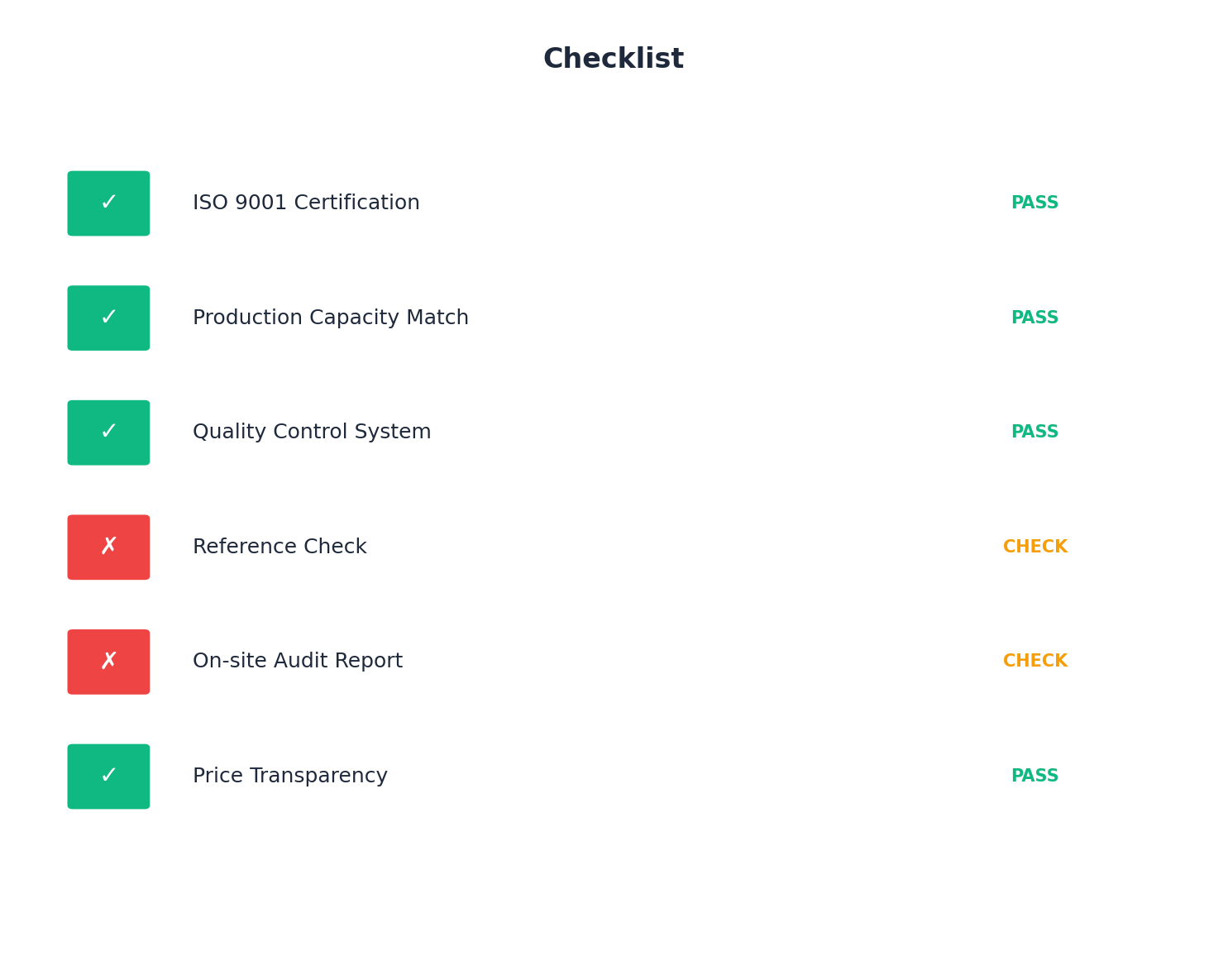
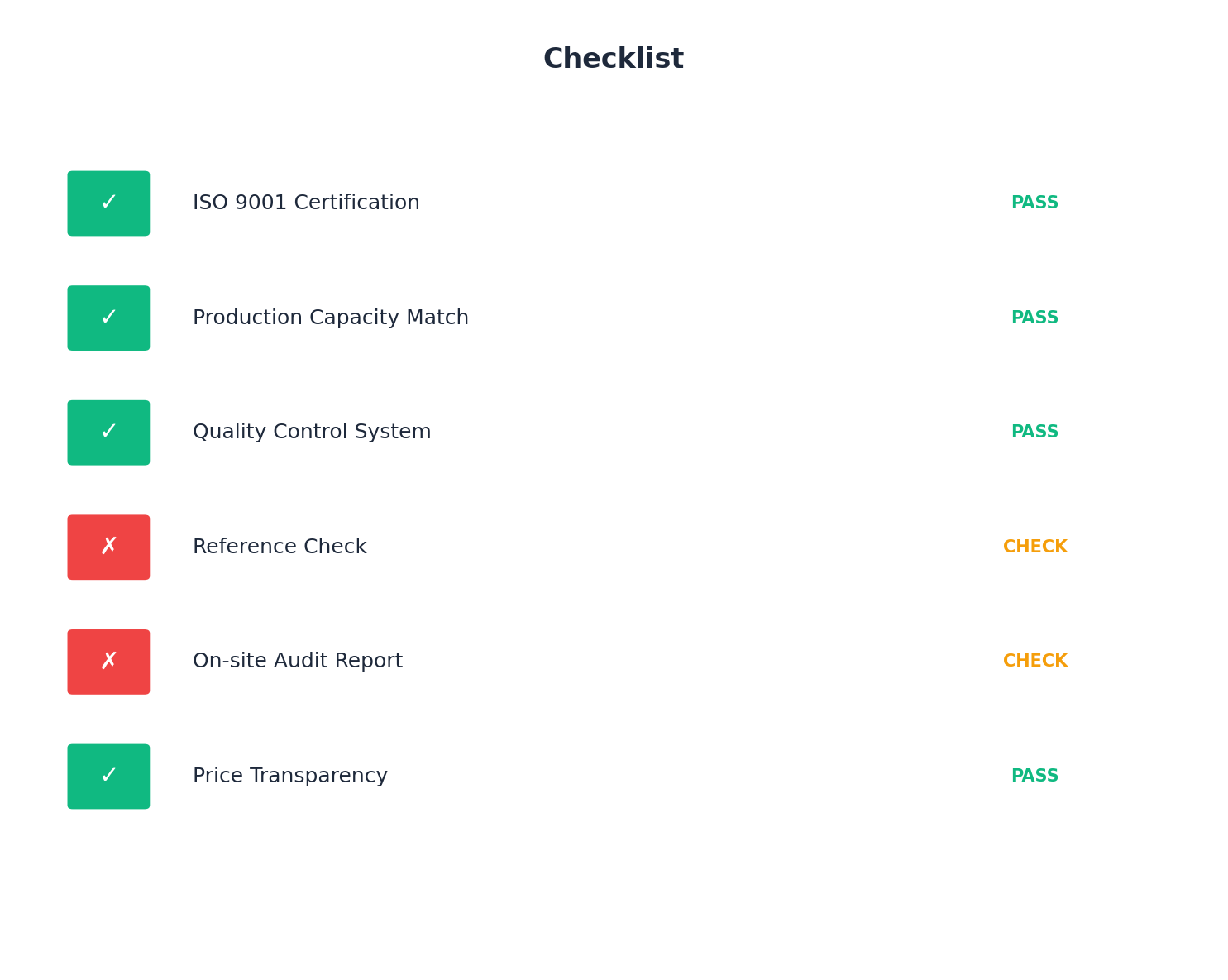
An IATF 16949 certificate is a starting point. Here's what actually tells you whether a foundry can hold your program.
1. Verify the certificate scope covers casting
Pull the certificate from the IATF database (iaf-cert.org or the registrar's directory). Confirm the scope includes the casting process you're buying, covers the site where the work will happen, and hasn't been suspended. Certificates get suspended for a reason, usually a major nonconformity in a previous surveillance audit.
2. Get the PPAP file for a similar existing program
Not a blank template. An approved PPAP from a current automotive customer, with the foundry's name and part number visible (they can redact the customer name under NDA). Read the PFMEA, the control plan, and the dimensional report. That is what your package will look like.
3. Walk the shop floor against the PFMEA
Take the PFMEA to the production line. Does the sequence of processes match? Does the station the PFMEA calls out as a detection point actually exist? Is the operator performing the check the control plan describes?
This is where most programs fall apart. The documents say one thing. The shop floor does another. Find the point where they diverge and ask why.
4. Random-check gauges and calibration
Pick three gauges on the line and check the calibration labels against the calibration log. Confirm the calibration lab's accreditation. Confirm the Gage R&R for each gauge used parts similar to production parts. If a gauge is past calibration or unlabeled, ask how many parts have shipped against it.
5. Trace one part heat-to-shipping
Ask to see a finished part, then trace its furnace or melt number back through the melt log, the material cert, the heat treatment record, and the inspection records. Then reverse it: pick a melt number from the log and confirm you can identify every casting made from it. That's clause 8.5.2 traceability in operation, and it's one of the most commonly failed areas in casting audits.
6. Ask to see the nonconforming material area
There should be a clearly identified, physically segregated quarantine area with a log. Read the last 90 days of it. Look for repeat items: same defect code, same part, over and over. Repeat entries tell you corrective action isn't closing. Under IATF 16949, corrective action must include root cause analysis and verification of effectiveness, not a line that says "operator retrained."
7. Review closed 8Ds from the last 12 months
Pick two or three 8D reports closed on automotive parts. Read the root cause. Read the verification of effectiveness. If the answer to "why did this happen" is "operator error" more than once out of three, the foundry isn't doing root cause analysis. They're documenting a shrug.
Common Mistakes Buyers Make
A few patterns repeat across nearly every IATF casting program that goes sideways. If you've run sourcing long enough, you'll recognize all five.
Treating the certificate as the quality system. The certificate confirms that a certification body audited a management system on a specific day. It doesn't confirm that the specific die on your program will hold tolerance. Do your own verification on your own program.
Accepting the Tier-1 PPAP without auditing the Tier-2. If your casting supplier subcontracts heat treatment, machining, impregnation, or NDT, those sub-suppliers are part of the qualified process. IATF 16949 clause 8.4 requires supplier development and monitoring. If they can't name their subcontractors, they aren't monitoring them. Our sourcing guides include a sub-tier control checklist for exactly this.
Skipping the run-at-rate trial. A foundry that can produce ten good parts on a slow Tuesday is not the same as a foundry that can produce 800 parts a day at cycle and hold tolerance. Run-at-rate is where dimensional drift, tool wear, and cycle-time shortcuts show up.
Using a generic control plan. "All casting parts" is not a control plan. The control plan must be part-specific, listing the actual features, the actual measurement methods, the actual sample sizes and frequencies, and the actual reaction plan when out of spec.
Ignoring VDA 6.3 if you're a European Tier-1. IATF 16949 is the base. VDA 6.3 is the process audit standard most German OEMs and Tier-1s use on top of it. If your customer is German, or if you're supplying into a German OEM's supply chain, VDA 6.3 readiness is table stakes. A supplier that has never heard of a P6 process audit will struggle, and you'll find out during the award audit rather than before it.
FAQ
Is IATF 16949 mandatory for a casting supplier?
If you're supplying parts into the automotive supply chain and your customer requires it, yes, by contract. The standard itself applies to any organization that manufactures production parts or provides services for automotive customers. There are carve-outs (aftermarket parts, some non-automotive work), but for a Tier-1 or Tier-2 program, IATF 16949 is almost always written into the terms.
Can ISO 9001 substitute for IATF 16949?
No, not for automotive production parts. ISO 9001 is a generic QMS standard and doesn't carry the automotive-specific requirements: PPAP, control plan linkage, MSA, SPC, cascade requirements. Some buyers will accept ISO 9001 for low-risk, non-safety-relevant parts, but any OEM-facing program that touches safety, regulatory compliance, or structural function will require IATF 16949.
How long does a PPAP take?
Realistically, 6 to 14 weeks from the point where the foundry has a production die and production-intent parts. The bulk of that time is capability studies (300-piece runs), MSA, and closure of any nonconformities found during dimensional review. Add 4 to 6 weeks if the foundry has to develop a subcontractor or qualify a new tool. Anyone promising a two-week PPAP is either cutting corners or has already run the process for an identical part.
How long does PPAP approval stay valid?
Until something changes. Under the AIAG PPAP manual, resubmission is required for design changes, process changes, tooling changes, supplier changes, or when production has been interrupted for more than 12 months. Your customer may specify a shorter interval. Real-world advice: assume any change to the die, the press, the alloy, the heat treatment cycle, or the subcontractor requires a conversation before production resumes.
Are Chinese foundries actually IATF 16949 certified?
Many are, and the number has grown steadily since the standard was introduced. As of the most recent IATF certification data, China accounts for one of the largest populations of certified automotive sites globally. That said, the quality of implementation varies dramatically. A certified foundry in Guangdong and a certified foundry in Jiangsu can be 100 miles apart and 10 years apart in process maturity. The certificate gets them into the room. The audit is what tells you whether they can hold the program.
Next Steps
If you're evaluating a casting supplier for an automotive program, the sequence that saves the most time is this: verify scope, request an actual PPAP from a similar program, walk the floor with the PFMEA, and check three things by hand—calibration labels, heat traceability, and 8D closure. Everything else can be verified later. Those four checks will tell you in about half a day whether the foundry can hold the launch date.
If you'd rather have someone run that verification on the ground before you commit, that's what a sourcing partner does: audit report, sample parts, and an honest read on the foundry's real capability, before the tooling is cut. Our vetted foundry directory is pre-screened on exactly the seven points above.
Request a foundry audit and PPAP review →
Need Help with Automotive Casting Quality Standards: IATF 16949 Guide?
Get matched with 3 verified foundries in 24 hours. No markup, transparent pricing.
Request Quotes →