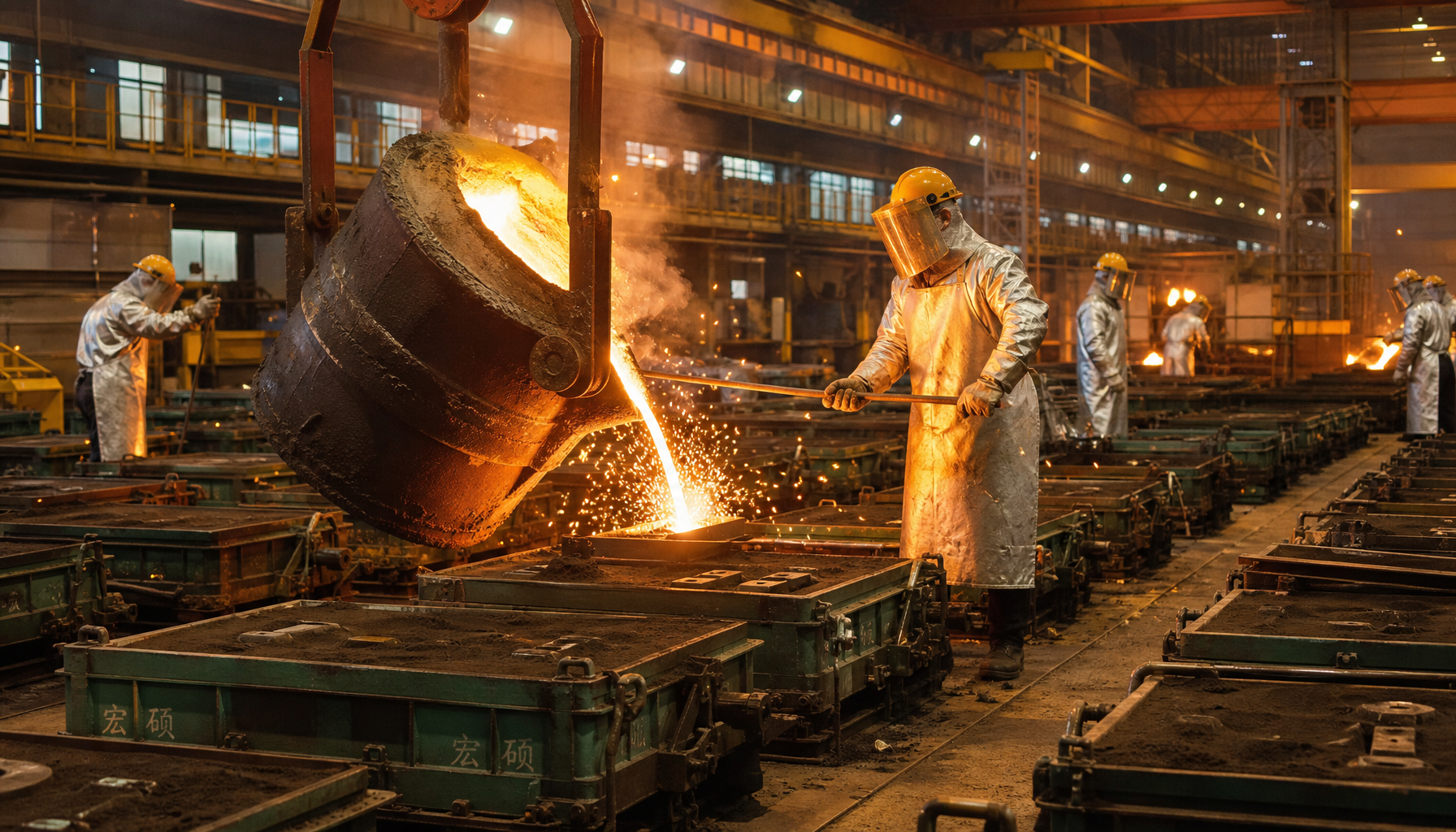
The container cleared customs on February 14, 2023. Two days later my assembly lead walked into my office holding a gearbox housing and a bore gauge.
"Tenth housing in a row. The input shaft bore is 0.9 millimeters off center. Every single one."
Two hundred gearbox housings sat on my floor. My spring planting window opened in six weeks. You cannot machine around a bore that's in the wrong place. I air-freighted 40 replacement castings from a backup shop in Wisconsin at $310 apiece. The Chinese castings had cost $47 each.
That was a $23,000 lesson, and it wasn't the failure mode I'd been guarding against. I'd spent weeks sweating porosity and chemistry. Nobody warned me about pattern shift.
If you're sourcing agricultural machinery castings from China right now, there's a decent chance you're also guarding the wrong door. This is what I wish someone had handed me in 2022.
Why ag castings fail differently than automotive castings
Ask a Chinese foundry to quote your ag castings using automotive assumptions and you'll get the wrong process, the wrong tolerances, and a price that looks great until the parts show up.
The two industries buy castings in ways that barely overlap:
- Volume. An automotive program might run 80,000 pieces a year. Your compact tractor gearbox runs 1,200. That changes everything about what tooling the foundry is willing to build.
- Load profile. Ag parts take shock loads constantly. A three-point hitch lower link sees impact cycles that would destroy an automotive bracket. Designers compensate with thicker sections, not exotic alloys.
- Service environment. Dust, mud, standing water, -30°C winters, 45°C summers, and a farmer who greases things once a season whether they need it or not. Corrosion resistance and surface integrity matter more than you'd think.
- Warranty math. A failed automotive casting gets you a service bulletin. A failed hitch casting gets you a lawsuit and a recall.
The practical result: agricultural castings skew toward thicker walls, more generous fillets, and gray iron over lighter materials. Typical parts in this category include:
- Transmission and gearbox housings (gray iron, ASTM A48 Class 30-35)
- Differential carriers and axle housings (ductile iron, ASTM A536 65-45-12)
- PTO clutch housings and yokes
- Front loader mounting brackets and torque tubes
- Three-point hitch components and draft links
- Wheel hubs, spindles, and steering knuckles
- Harvester sieve frames and auger troughs
- Wear parts — plow shares, discs, hammer mill screens (high-chrome iron or boron steel)
The four casting processes you'll get quoted
Your quotation pack will probably include three or four of these. Each has a different cost curve, and picking the wrong one is the most common way buyers overpay or under-spec a part.
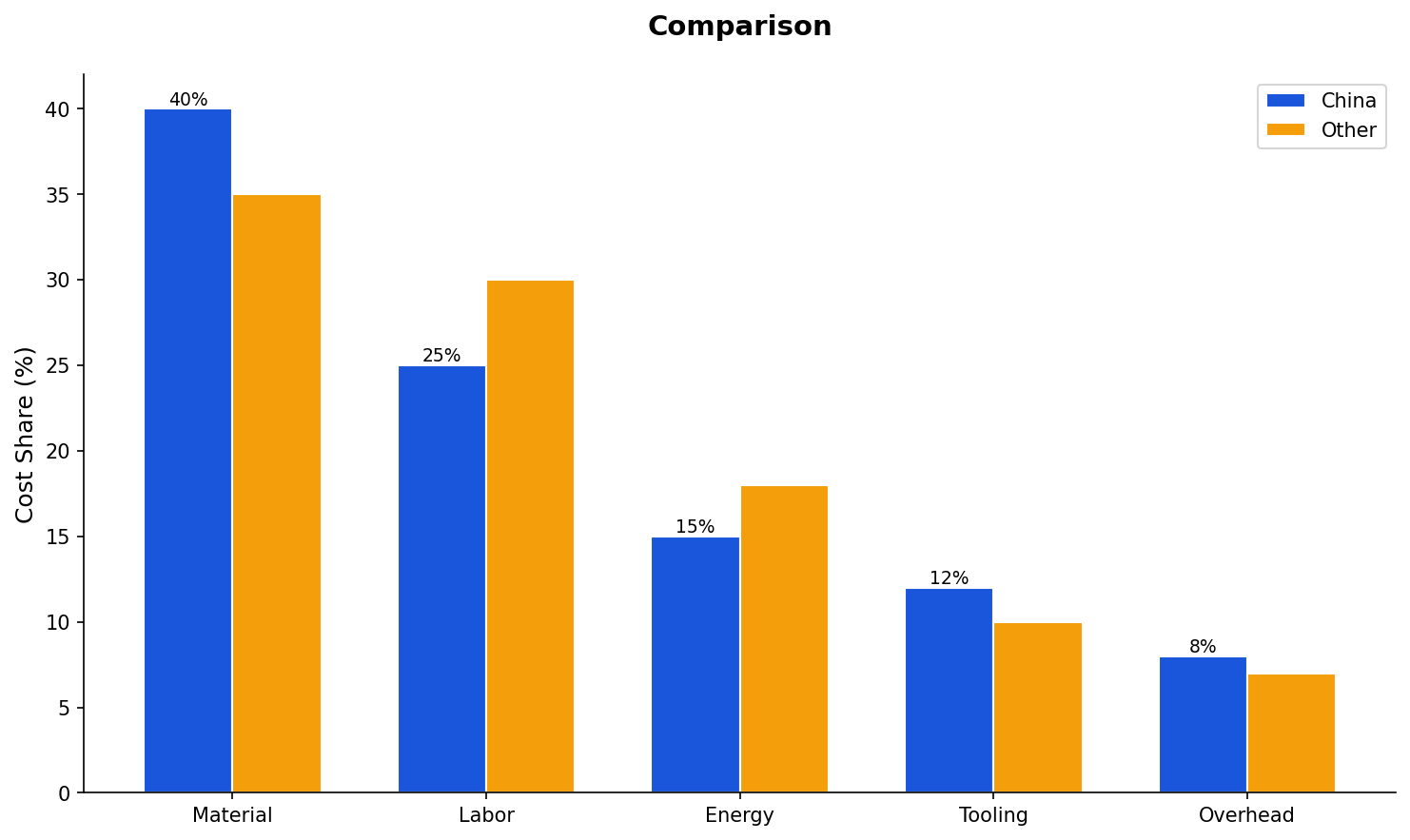
| Process | Tolerance (ISO 8062) | Tooling cost | Economic batch | Best fit |
|---|---|---|---|---|
| Green sand | DCTG 8-10 | $600-$2,500 | 100-10,000+ | Gearbox housings, brackets, anything big and boxy |
| Resin-bonded sand | DCTG 7-9 | $1,200-$4,000 | 50-5,000 | Parts with multiple cores, better surface finish |
| Investment (lost wax) | DCTG 5-7 | $3,000-$15,000 | 500-50,000 | Small precision parts, PTO yokes, machined-as-cast fittings |
| Lost foam | DCTG 7-9 | $2,000-$8,000 | 200-20,000 | Complex internal cavities, no parting line |
| Gravity die / permanent mold | DCTG 5-6 | $8,000-$25,000 | 5,000+ | High-volume ductile iron hubs, fine grain structure |
Here's the trap. If you send a 400-piece, 18-kilogram gearbox housing to a foundry that specializes in investment casting, they'll quote it. They'll quote it badly, because their cost model assumes amortizing a $12,000 wax die over 20,000 pieces. Your unit price will look like it belongs on a different part.
Tell the foundry your annual volume in the first email. Not the first order — the annual. A foundry that knows you'll come back twice a year prices differently than one that thinks you're a one-off.
What your landed cost actually looks like
The FOB number on your quotation is roughly 50-55% of what you'll actually pay to get castings in your warehouse. Buyers who model only the FOB price are usually off by a factor of two, and that's before anything goes wrong.
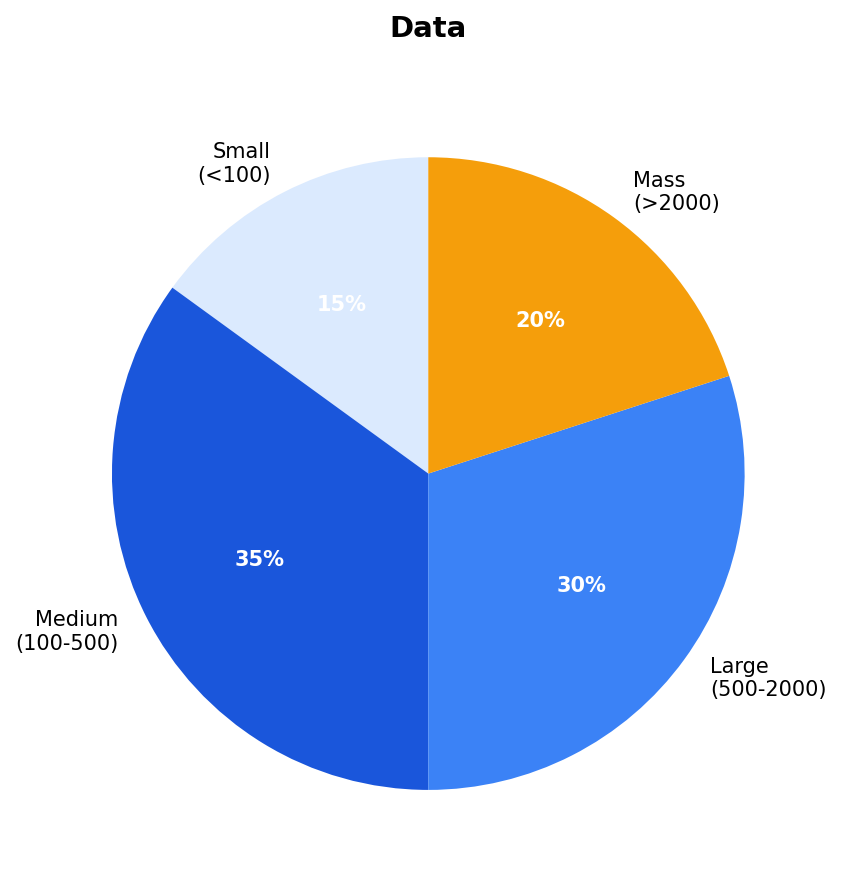
Take a 12-kilogram gray iron gearbox housing. Rough numbers, late 2026, US Midwest destination:
| Line item | Cost per piece |
|---|---|
| Raw casting, FOB Qingdao ($1.80/kg) | $21.60 |
| CNC machining (3 faces, 12 holes) | $14.00 |
| Primer and topcoat | $3.00 |
| Export-grade wood crate + VCI | $2.50 |
| Ocean freight, allocated | $3.20 |
| Section 301 duty (25%) | $10.30 |
| Inland trucking + port fees | $1.40 |
| Pre-shipment inspection, allocated | $0.80 |
| Landed cost | $56.80 |
The same housing from a US foundry with the same machining runs $92-110. So you're saving 40-48%, not 70%. That's still a real number — it's just not the number most people carry in their head when they start sourcing.
Two line items deserve special attention.
Duty. Iron and steel castings fall under HS heading 7325. As of late 2026 these sit on the Section 301 List 3 schedule at 25%, on top of an MFN rate of 0-2.5%. Confirm the current rate with your customs broker before you sign a supply agreement, because these numbers have moved before and will move again. Build the duty into your cost model as a percentage, not a fixed dollar amount.
Tooling amortization. Pattern and core box cost gets quoted separately, and it's easy to forget that it's a real cost. A $3,500 pattern spread over a 1,500-piece annual order is $2.33 per piece in year one. In year two it's free. Don't let a supplier bury it in the unit price — keep it as a separate line so you can see what you're actually paying for.
The seasonal trap nobody warns you about
Chinese New Year in 2027 falls on February 6. Effective foundry shutdown starts about two weeks before that and runs about two weeks after, because the migrant workforce that does the pouring goes home and doesn't all come back on schedule.
Now look at when North American farmers actually buy equipment. Spring planting in the Corn Belt runs mid-April through late May. Dealers stock replacement parts in February and March. Your castings need to be in a dealer's warehouse by late February at the latest.
Work it backward and the schedule gets uncomfortable:
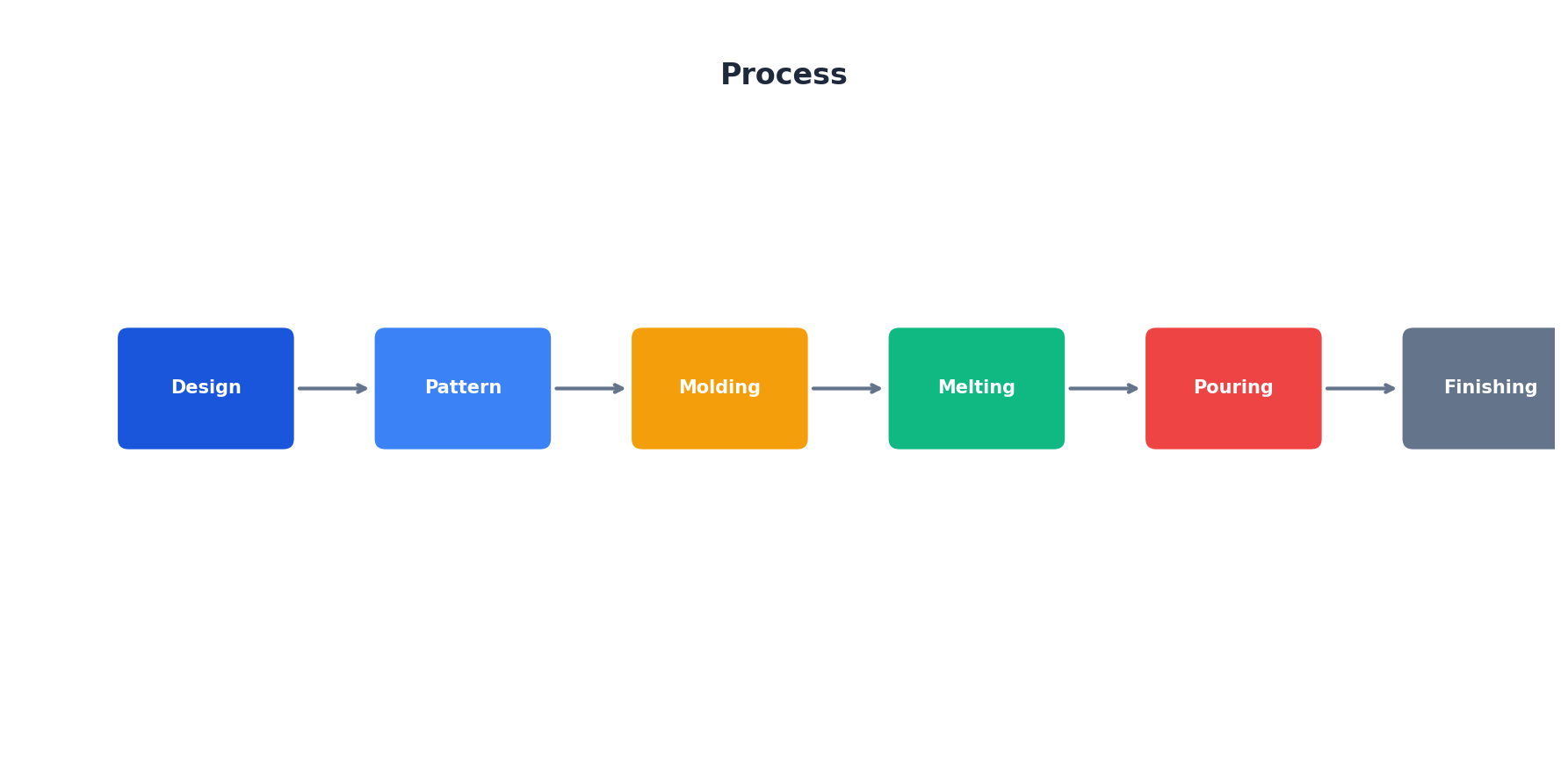
- August 2026 — tooling PO released. Pattern and core box fabrication begins.
- October 2026 — first articles arrive, you approve or send back for correction.
- November 2026 — production run starts. This is the last comfortable window.
- January 15, 2027 — hard cutoff for pre-CNY shipment. Miss this and you're waiting until March.
- February 6-20, 2027 — foundry is dark. Nobody answers email.
- Late February 2027 — your container lands. If you shipped by January 15.
Miss the mid-January cutoff and your next realistic shipment date is around March 5, with arrival in early April. That's the week dealers are already placing their final spring orders. You've lost the season, and the castings sit in your warehouse for ten months.
One more thing: the pre-CNY rush is real. Freight rates on the trans-Pacific lanes typically spike 15-30% in the six weeks before the holiday, and space gets tight. Book your ocean freight in November, not January.
Quality checks that catch problems at the foundry, not at your dock
I don't run a foundry and I've never claimed to. So on quality questions I lean on people who've spent decades walking Chinese foundry floors. Brian Miller sources replacement castings for a Georgia farm-equipment distributor network and has audited more than a hundred suppliers across Shandong, Hebei, and Jiangsu.
"Every quality failure I've seen in fifteen years traces back to a buyer who didn't define what 'good' meant. The foundry isn't psychic. If your drawing shows eight dimensions and none of them are marked critical, you've told them all eight matter equally. They'll hold the easy ones and hope on the hard ones."
— Brian Miller, Georgia
What that means practically: your drawing should flag critical-to-function dimensions with a tolerance and a measurement method. If your input shaft bore is critical, it needs to be a coordinate-measured dimension with a stated tolerance band of ±0.1mm or tighter, not just a nominal size on a general arrangement drawing.
Beyond that, these are the checks that actually catch problems:
- Spectrometer analysis on every heat. Not a certificate — a live reading. Ask for a photo of the printout for your specific heat number. If the foundry won't provide it, that's your answer.
- Hardness testing on the casting itself. Brinell for gray iron (expect 170-220 HB for Class 30), and it should be measured on a machined face, not the as-cast skin.
- First article dimensional report. Every dimension on the drawing, measured by CMM or calibrated hand tools, on the first three parts off the pattern. Not one part. Three, from different molds.
- Microstructure check. Flake graphite distribution for gray iron, nodularity above 80% for ductile. This is what catches a foundry that dumped the wrong inoculant.
- Weight check. Any casting more than 5% over nominal weight means the wall sections are wrong, and that usually means the pattern or the cores are drifting.
- Coating adhesion. ASTM D3359 crosshatch tape test on a painted sample. Paint that passes at the foundry and falls off after a season in the field is a warranty claim waiting to happen.
The first article report is where I'd spend the money. It's $150-$400 from a third-party lab and it will catch 90% of the problems that would otherwise show up six weeks later on your assembly floor.
Certification and compliance you actually need
There's a lot of noise about paperwork in this space. Here's what matters and what's just decoration.
"A mill test certificate means nothing if it's not traceable to a heat number stamped on your part. We stopped accepting generic certs in 2019 and our warranty claims dropped about 40% within a year. Ask for EN 10204 3.1 or 3.2, and check that the heat number on the paper matches the heat number cast into the part."
— Brian Miller, Georgia
The traceability chain is the whole point. A certificate that was generated after the fact, for a heat that can't be tied to your specific castings, is a piece of paper.
What to require:
- ISO 9001 — non-negotiable baseline. Any foundry exporting to North America should have it. Verify the certificate number on the issuing body's website; there are far more fake ISO certs in circulation than most buyers realize.
- EN 10204 3.1 material certificates — tied to the heat number, stating chemistry and mechanical properties.
- Heat number stamped or cast into every part — mandatory for traceability. If the part is too small, a heat number on the bag or pallet label with a documented link to the order is acceptable.
- Heat treatment records — for any ductile iron that requires stress relief or normalizing.
- Third-party pre-shipment inspection — SGS, Bureau Veritas, TÜV, or a regional inspector. Budget $250-$500 per man-day.
- ISO 14001 and IATF 16949 — nice to have. IATF matters if the same casting crosses over into an automotive application.
One thing to skip: the twelve-page PowerPoint about the foundry's "quality philosophy." Ask instead for a photo of the spectrometer printout for your heat. That will tell you more in ten seconds than the deck will in an hour.
A five-step factory verification you can run in one day
You don't need to fly to China to know whether a foundry is going to work out. You need a checklist and a video call.
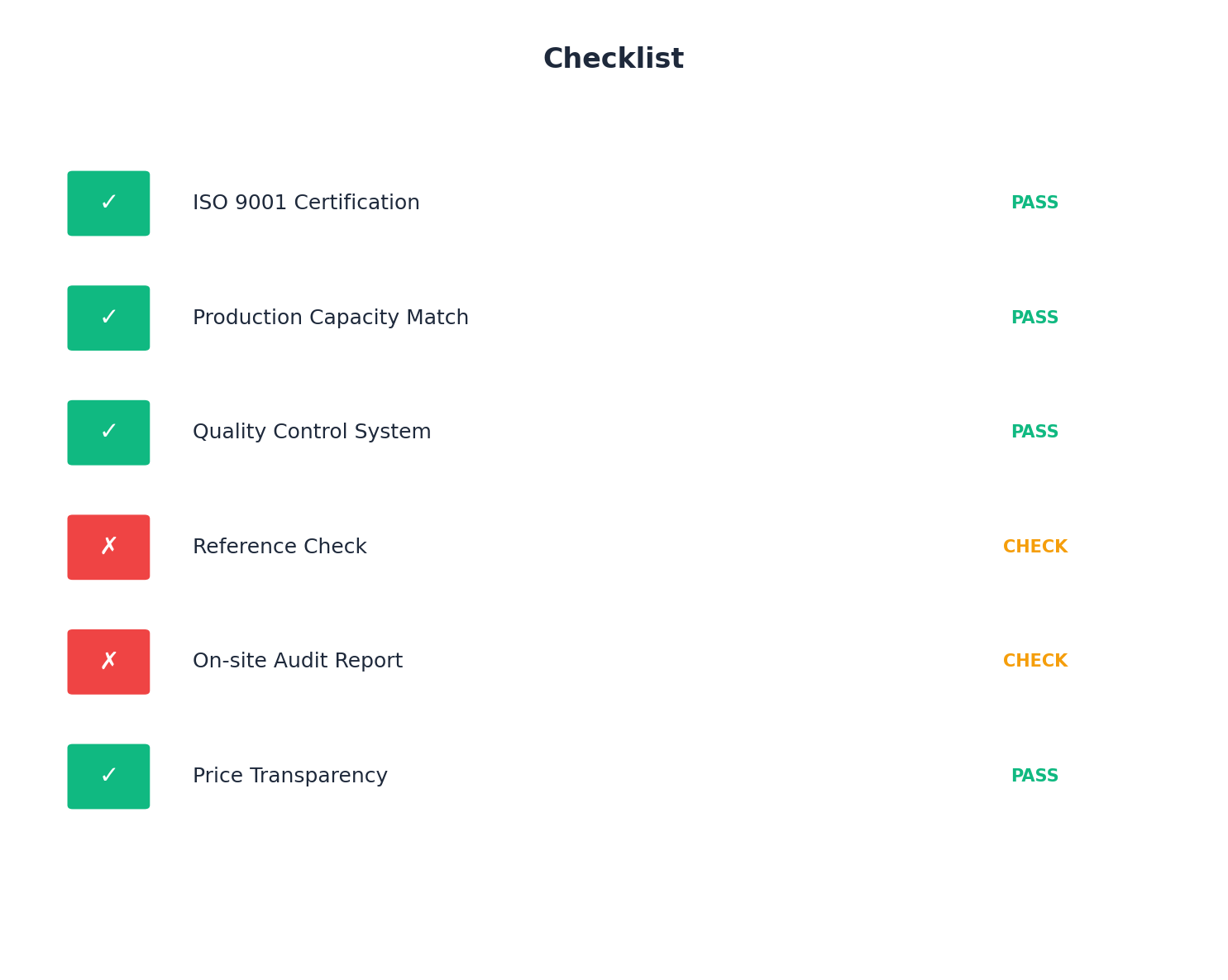
Step 1: Pattern and tooling review. Ask for a video walkthrough of the pattern shop with your tooling visible. Check the pattern for wear — sharp edges, chipped fillets, and dirt-packed corners all telegraph into your castings. Ask when the pattern was last refurbished.
Step 2: Melt chemistry and spectrometer check. Schedule a video call during a pour of your heat. Watch them pull the sample and run the spectrometer. Ask them to show you the readout live, not a PDF afterward. This is the single most revealing step, and the least negotiable.
Step 3: First article dimensional report. Review the report line by line against your drawing. Anything out of tolerance gets a decision: accept with documented deviation, rework, or reject. Do not accept "close enough" — the bore that's 0.9mm off is close enough right up until assembly day.
Step 4: Coating adhesion test. Have them paint a sample and run the crosshatch test on camera. Cheaper than discovering the problem after a season in the field.
Step 5: Pre-shipment inspection with photos. Before the container seals, get dated photos of every pallet, every heat number stamp, the packing method, and the container door closing. This is where a third-party inspector earns their fee.
"Bring a micrometer and your part drawing. If they can't measure your critical dimensions while you watch, they can't hold them when you're 7,000 miles away. I've walked away from foundries with great prices because the QC room had a caliper that hadn't been calibrated since 2018."
— Brian Miller, Georgia
Mistakes that cost the most
Four failures show up over and over. Every one of them is avoidable with a paragraph in your PO.
Buying on FOB price alone. The cheapest quote is usually the cheapest because something was left out — machining, coating, packing, or inspection. Ask for a full landed-cost model from three suppliers using the same scope. The spreads will shock you.
Not marking critical dimensions. If your drawing doesn't say which dimensions matter, you've handed the foundry a coin flip. Mark them. State the tolerance and the measurement method.
No tooling ownership clause. Write it into the contract: patterns, core boxes, and fixtures are the buyer's property, and the foundry must release them on request. Without that clause, switching suppliers means paying for tooling twice.
Ignoring Chinese New Year. Every year, buyers get caught. Every year, someone's castings sit in a dark foundry for three weeks while the planting season passes. Put the CNY dates on your sourcing calendar in August, not January.
One more, less obvious: accepting a generic material certificate. A certificate that can't be traced to the heat number cast into your part is not a certificate. It's a piece of paper with a logo on it.
Frequently asked questions
How much do agricultural machinery castings from China cost?
Raw gray iron castings run $1.10-$1.70/kg FOB for simple parts and $1.70-$2.60/kg for complex cored parts. Ductile iron sits at $1.40-$2.20/kg. Machining adds $0.80-$2.50/kg depending on operations. Once you add ocean freight, Section 301 duty, inland transport, and inspection, expect landed cost to be roughly 1.8-2.1x the FOB price. Those are 2026 ranges and they move with scrap prices and freight rates.
What's the minimum order quantity for ag castings from a Chinese foundry?
Green sand foundries will quote 100-piece batches if the pattern is simple and there are no cores. Cored parts usually start at 300-500 pieces. Investment casting starts at 500-1,000. Below 100 pieces you're paying setup cost that doesn't amortize, and most foundries will price it accordingly rather than turn you away.
How long does it take to get castings from China?
Tooling takes 30-45 days from drawing approval. First articles add 12-18 days including shipping. A 500-2,000 piece production run takes 30-45 days depending on the foundry's queue. Ocean freight to the US West Coast is 22-30 days; East Coast is 32-42 days. Plan on 4-6 months from drawing to dock for a first order, and 3-4 months for repeats.
Are Chinese agricultural castings subject to tariffs?
Iron and steel castings under HS 7325 are on the Section 301 List 3 schedule at 25%, plus MFN duty of 0-2.5%. Total duty burden usually lands between 25% and 27.5% of declared value. Rates have changed before. Verify the current figure with your customs broker before you build a landed-cost model on it.
How do I verify a Chinese foundry without flying there?
Run the five-step remote verification above: pattern review by video, live spectrometer check, first article dimensional report, coating adhesion test, and pre-shipment inspection with dated photos. Hire a third-party inspector for the final step. It costs $250-$500 per man-day and catches most problems while they're still fixable at the factory.
What to do next
If you're sourcing agricultural machinery castings from China for the 2027 season, the calendar is already tight. The tooling window for a January shipment closed in September. If you haven't started, you're looking at a spring 2028 delivery for a first order, or a rush job with rush pricing.
Three things to do this week:
- Get your drawings in order. Mark critical dimensions, state tolerances, and include a measurement method for each. This one step eliminates more rework than anything else you can do.
- Ask three foundries for a full landed-cost model, not an FOB price. Specify the scope: raw casting, machining, coating, packing, inspection, FOB port.
- Put the Chinese New Year dates on your sourcing calendar for the next three years. The 2027 holiday starts February 6. The 2028 holiday starts January 26. Build backward from those dates.
That $23,000 lesson I paid in 2023 came down to one missing line on a drawing. A critical dimension that wasn't marked. Sixty seconds of drafting time, four figures of air freight, and a very unpleasant phone call with my assembly lead.
You can skip that part.